
A thermostat reads one spot in your house and nothing else. The room that never cools is usually getting a fraction of the airflow the plans assumed, and the only way to know is to put a hood on the register and read the number. We measure every supply in the house, compare what each room gets against what it needs, and adjust dampers, duct and grilles until the readings match.
Almost every week somebody in Paradise tells us the same story. The living room is fine. The back bedroom is nine degrees warmer by four in the afternoon, and it has been like that since they moved in. Somebody already came out, put gauges on the condenser, said the charge was good, and left. Nothing changed.
Nothing changed because the equipment was never the problem. The equipment was making cold air the whole time. It just was not arriving in that room, and there is no gauge on a condenser that can tell you so.
What the Thermostat Cannot See
Your thermostat is a single sensor on a single wall, usually in a hallway or the main living space. It reads the temperature at that spot and decides whether the system runs. That is the entire extent of its knowledge about your house. If the hallway hits 75, the system shuts off, and the back bedroom stays at 84 with the door closed and the sun on the west wall. From the thermostat’s point of view the job is done.
Smart thermostats do not change this. They add scheduling, remote access, and sometimes a remote sensor you can put in the problem room, which is genuinely useful for deciding when to call for cooling. What a remote sensor cannot do is make more air come out of that register. If a room is starved, telling the system to run longer means the rest of the house gets overcooled while the starved room crawls a couple of degrees closer. You are paying to freeze the living room in order to slightly improve the bedroom. We see that setup a lot and it is always a workaround for an airflow problem nobody measured.
What the Hood Actually Measures
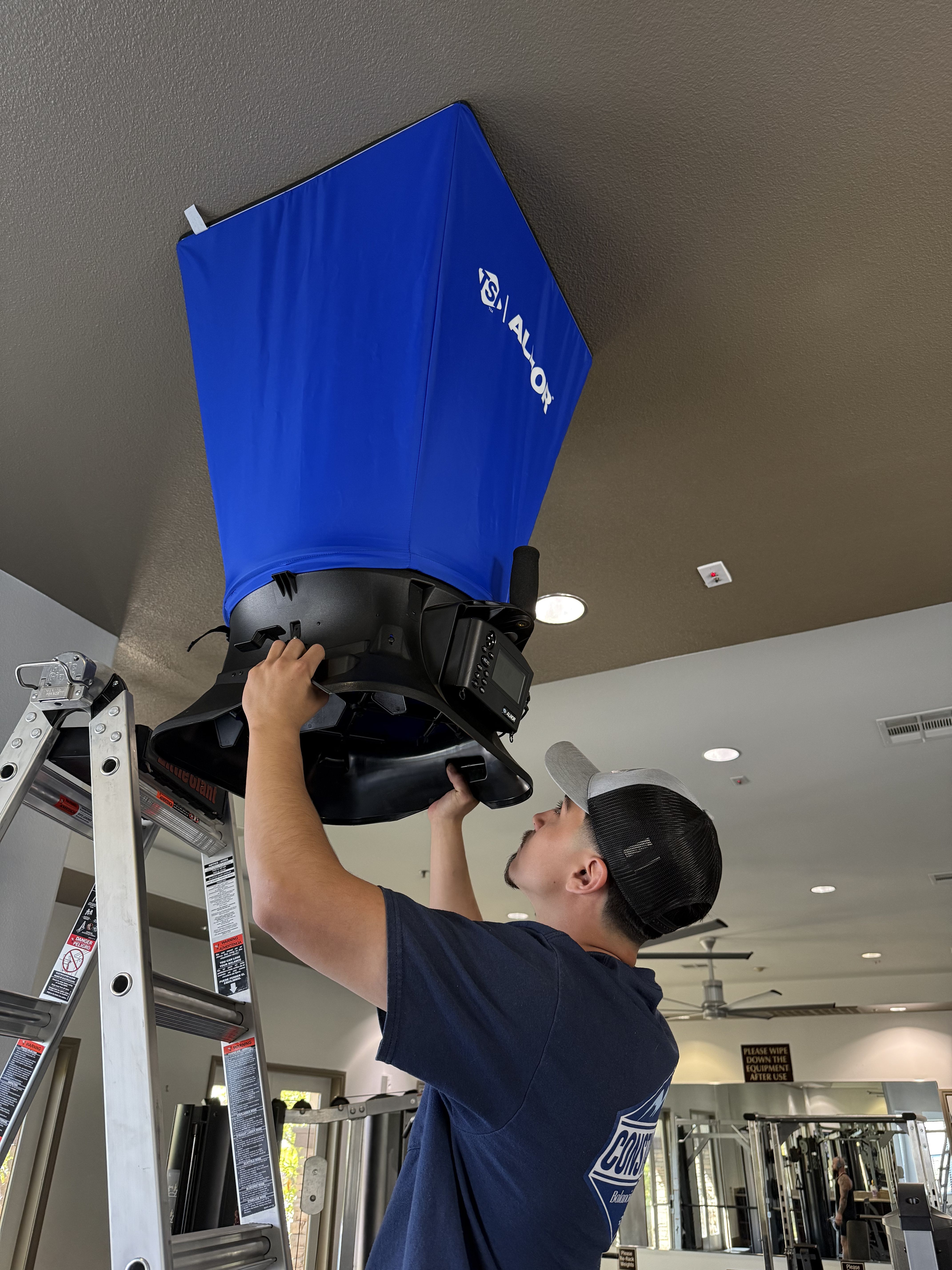
A balancing hood is a fabric-sided funnel with a calibrated grid inside it. We seal it over a register and it tells us how much air, in cubic feet per minute, is coming out of that opening. Not whether air is moving. How much. That single number is what separates measuring from guessing.
Then it gets compared against what that room needs, which comes from the room’s size, its exposure, its window area, and what the rest of the system is delivering. A bedroom that should be getting 110 and is getting 40 explains itself immediately. So does the opposite case, which happens more than people expect: a room right off the air handler getting far more than its share, stealing from everything downstream of it. Our air balancing service is built around that comparison, room by room, with the readings written down.
Paired with the hood we read static pressure across the coil and the filter. That tells us whether the whole system is working against too much resistance, which is a different problem with a different fix. A house can have perfectly even airflow and still be strangled everywhere at once. You only find that out with a manometer.
Why a Duct Can Look Fine and Still Starve a Room
This is the part that surprises homeowners. Somebody goes into the attic, shines a light, sees flex duct running to the bedroom, and reports that everything looks connected. That observation is nearly worthless, because most of the ways a duct fails are invisible to the eye.
Flex duct that is not pulled taut sags between supports, and every sag is a bend that eats airflow. A run that is thirty feet of actual duct covering fifteen feet of distance is losing air to friction the whole way. A kink where the duct turns over a truss chord can cut a run nearly in half and still look like a normal duct from six feet away. Collars that were never sealed leak conditioned air into the attic before it ever reaches the room. Older construction near downtown often has original ductwork that has never been properly balanced, and in those houses we frequently find dampers that were set at rough-in, painted over, and never touched again.
Then there is the register itself. A ceiling diffuser with the wrong throw pattern dumps air straight down into the middle of the room instead of spreading it along the ceiling, so the room feels drafty in one spot and stagnant everywhere else. The number at the hood can be correct and the room still uncomfortable, which is why we look at the register as well as the reading.
What We Change, in What Order
Balancing is not a single adjustment. It is a sequence, and doing it out of order wastes the trip.
We start with the things that affect the whole system, because moving one damper before the total airflow is right just redistributes a shortage. Filter condition, coil cleanliness, blower speed, and the return path all come first. A system that cannot pull enough return air has nothing to distribute no matter how the dampers sit.
Then we work the branches. Balancing dampers in the trunk get set, sagging runs get supported or shortened, kinks get straightened, open collars get sealed. Where a run is simply too long or too small for the room it serves, we say so plainly rather than pretending a damper can fix geometry. Last come the registers, because the throw pattern only matters once the volume is right.
At the end we re-read every register and write the readings down. The report shows what each room was getting before and what it is getting now. That document is the proof, and on a commercial job near the Strip it is usually a contract requirement.
When It Is Not Balance at All
Sometimes we measure and the airflow is right, and the room is still hot. That happens, and it means the room is gaining more heat than the air can carry off. A west-facing wall with single-pane glass, an uninsulated ceiling over a converted patio, a room over a garage. In those cases balancing the system to feed that room more air helps, but the honest answer includes the envelope, and we will tell you that rather than sell you a balance that cannot win.
The other case is a system that is genuinely failing and needs a technician with gauges. If the whole house is losing ground and not just one room, start at the Paradise repair page instead. Different symptom, different tool.
Questions About Hot Rooms
Will closing vents in other rooms push more air to the hot one?
A little, and at a cost. Closing supplies raises system pressure, which makes the blower work harder and increases duct leakage everywhere else. You also risk freezing the coil if you close too many. It is a blunt version of what a proper damper adjustment does with control, so we would rather set it correctly once.
How long does a whole-house balance take?
Most single-family homes are a half day to a day, depending on how many supplies there are and how much attic work the adjustments require. Condominiums and apartments are usually quicker because there are fewer runs. You get the written readings either way.
Do I need to be home for it?
Yes, at least for access. We need to get into every conditioned room to read each register, plus the attic or mechanical closet. Doors that stay locked are rooms we cannot measure, and an unmeasured room is the one that stays hot.
The Short Version
A thermostat knows one temperature in one hallway. A hood knows what every room is actually receiving. If one room in your Paradise home has never cooled properly, have us read the registers before anyone talks about replacing equipment that is probably fine.
Book a Balance for the Room That Never Cools
NCI-certified technicians, calibrated hoods, and a written report of every register in the house.
Free Quote (702) 840-5163