Spring Valley Air Balancing
Air balancing is the discipline this company was built around, and it runs the opposite direction from most residential shops: we came to HVAC service through balancing, not the other way around. In Spring Valley that means we show up with instruments, read the air coming out of every register and going back into every return, compare it to what each room actually needs, and adjust the duct system until the numbers agree. The hot upstairs bedroom almost always turns out to be an airflow problem, not a capacity problem.

The Eight Degree Upstairs, and What Actually Causes It
Drive any of the tract neighborhoods off Rainbow, Durango, or Jones and you will find the same two story stucco house with a tile roof repeated a few hundred times. In July the upstairs of that house commonly sits eight to twelve degrees above the downstairs, all day, no matter where the thermostat is set. Almost every homeowner reaches the same conclusion: the air conditioner must be too small. We measure those systems for a living, and undersized equipment is rarely what we find.
What we find is air going to the wrong places. The thermostat lives downstairs, so it shuts the system off as soon as the first floor is satisfied while the second floor is still waiting on air that was never routed there in the right quantity. A thermostat reading is the temperature at one spot on one wall. It says nothing about how many cubic feet per minute reached the back bedroom.
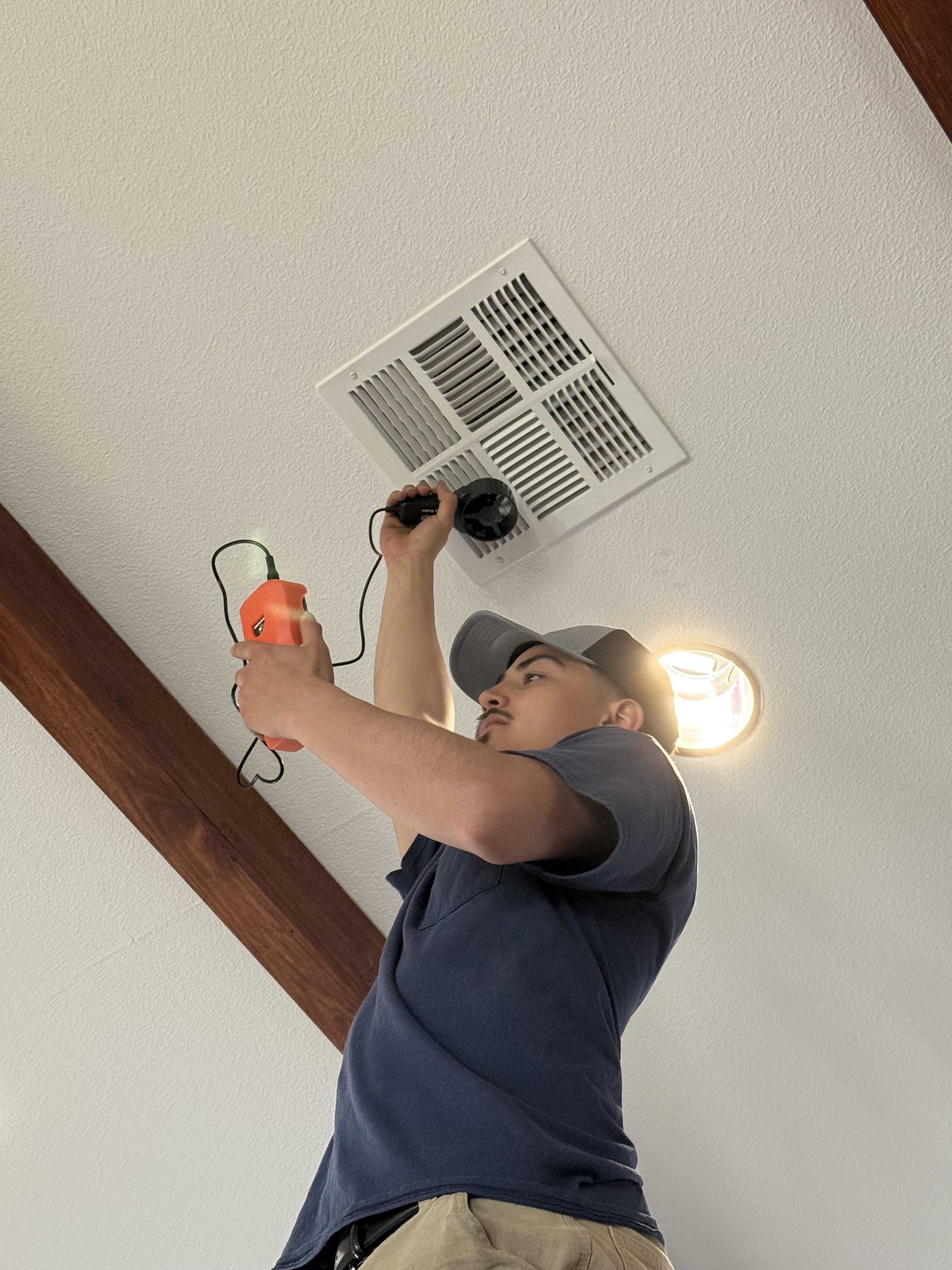
A visit starts at the air handler. We take static pressure across the equipment, note what the blower is fighting, and compare the total to what the manufacturer allows. Then we work room by room with a flow hood and a vane anemometer, logging what each register delivers and what each return pulls. Those numbers get compared against the load each room carries, which here means west facing glass, a two story stack effect, and an attic that turns into an oven by noon.
Then we change things. Dampers get set, takeoffs get corrected, crushed or sagging flex gets straightened and supported, and restrictions get opened up. After every adjustment we re-read the affected registers, because moving air toward one room always takes it from another. The job is finished when the whole house measures where it should, not when one bedroom feels better.
A Balance Report Versus a Guess
A guess sounds like this: close the downstairs vents halfway, put a fan at the top of the stairs, and see how it feels next week. Sometimes it helps a little. It also raises static pressure on a blower that was already working hard, and nobody wrote down a single number, so the next person to touch the system starts from zero again.
A balance report is a document. It lists the airflow at every supply and return before we touched anything, the airflow after, the static pressure readings at the equipment, and the final damper positions. Hand it to any technician who works on the house in the next fifteen years and they will know what the system was designed to do and whether it still does it. If a house cannot reach the numbers without duct changes, that goes in writing too. Tell us which rooms bother you before the visit and we will start there.
Why Spring Valley Duct Systems Drift
Most of this township went up between the late 1970s and the late 1990s, and the duct work reflects how houses were built and priced in that window. The single most common finding is one central return, usually in a hallway, sized for a smaller system than the one the house has now. When a blower cannot get enough air back, it cannot push enough air out, and no amount of damper work at the supply side fully fixes a starved return. Adding return capacity is often the single change that unlocks the rest of the balance.
The second finding is flex duct that was run long, run loose, and never supported the way the manufacturer requires. Thirty and forty foot runs sag between joists, kink at the turn into a boot, and lose pressure over every foot of that journey. The bedroom at the end of the longest run is almost always the room the family complains about. Straightening, shortening, and properly strapping those runs recovers airflow that was there all along.
The third finding is the simplest. Balancing dampers were installed at the takeoffs, left wide open on the day the house was finished, and have not moved since. Thirty years of homeowners have adjusted the little levers at the registers instead, which throttles air at the wrong end and makes the duct system noisier without redirecting much of anything. Setting the real dampers, in the right order, from the trunk outward, is a large part of what a balance visit is.
Condos and apartments change the job. In a shared building you have limited duct length, sometimes a shared shaft, and often a neighbor’s equipment influencing pressure in the space. We balance what is inside your walls, document what is beyond them, and say plainly which part is a building issue. The same logic applies to the restaurant and retail suites along Spring Mountain Road and the offices near Spring Valley Hospital, where a kitchen hood or one oversized rooftop unit pulls a whole suite out of balance. That work runs through our Spring Valley commercial HVAC service side.
Balance First, Then Decide About Equipment
Balance is not permanent, because houses change. A room addition tied into an existing trunk borrows air from everything downstream of it. New windows cut the load in a room that is still receiving the airflow the old windows needed, so that room now overshoots. A converted garage becomes conditioned space that the original duct design never accounted for at all. Every one of those projects is a good reason to have the airflow read again, and the work is far smaller than the remodel that made it necessary.
The bigger reason to measure comes up when someone tells a homeowner to replace the system. If the upstairs is short on air because of a starved return and sagging flex, a larger condenser cools the downstairs faster, shuts off sooner, and leaves the upstairs exactly as hot as it was. We have measured plenty of houses where the equipment was sized correctly and the duct system was the entire problem. Reading the numbers before writing a check is the cheapest step in the process.
When replacement genuinely is the right call, the measurements make that installation better, because we already know what the ducts can carry and what has to change for the new equipment to deliver its rating. That is the advantage of a balancing shop that also does full HVAC installation and HVAC repair in Spring Valley. Balancing also pairs with a furnace tune up and with indoor air quality work, since filtration changes airflow and airflow changes what your filtration can do.
Have the airflow read before the next hot week
Tell us which rooms never keep up and we will bring the instruments to find out why.
Questions Spring Valley Homeowners Ask Us
How long does a balance visit take?
A typical two story Spring Valley tract house runs four to six hours, because the measuring happens twice: once to establish what the system is doing now and again after the adjustments. Larger homes with multiple systems or added square footage take longer. Condo and apartment units are usually shorter. Small commercial suites depend on the number of zones and rooftop units involved.
Do you have to replace my air conditioner to fix the upstairs?
Usually not. Uneven temperatures are most often a duct and airflow problem, and the fix lives in the returns, the flex runs, and the dampers rather than in the equipment. We measure first and tell you what the numbers show. If we do find failing equipment we will say so, but a balance visit is far more often about moving air correctly than about buying anything.
What do I actually get at the end?
A written record of the airflow at every supply and return before and after, the static pressure readings taken at the equipment, and the damper positions we set. For a homeowner that is proof the system is delivering what each room needs. For a small commercial space it also gives a building owner or engineer something concrete to work from later.
My house is a 1980s build. Is that a problem?
It is the most common house we balance out here, and the patterns repeat. One undersized central hallway return, long unsupported flex runs to the far bedrooms, and balancing dampers that were left wide open the day the house was finished. None of those are defects you have to live with. They are all correctable, and correcting them is what makes the second floor livable in July.
Can you balance a condo or an apartment?
Yes, with one honest limit. We measure and adjust everything inside your unit, and where the imbalance traces back to a shared shaft, a common system, or a neighboring unit, we document that and explain it rather than charging you to chase something you do not control. Plenty of shared building units improve substantially from work done entirely inside the walls.
We just added a room. Does the whole house need rebalancing?
It should be re-read, yes. New duct tied into an existing trunk pulls air away from everything downstream, so rooms that were fine before the addition often go short afterward. The same applies after new windows or a garage conversion. It is a much smaller job than the remodel itself, and it protects the comfort you already paid for.
More Work We Do Around Spring Valley
All Spring Valley, NV services · See our work · Talk to us about your house
Where We Work in Spring Valley
We cover the whole township, from the Spring Mountain Road corridor and the neighborhoods around Spring Valley Hospital out to the newer infill west of Durango, plus the older tracts along Rainbow, Jones, Tropicana, and Flamingo, and the condo and apartment communities in between.