Sloan HVAC Repair
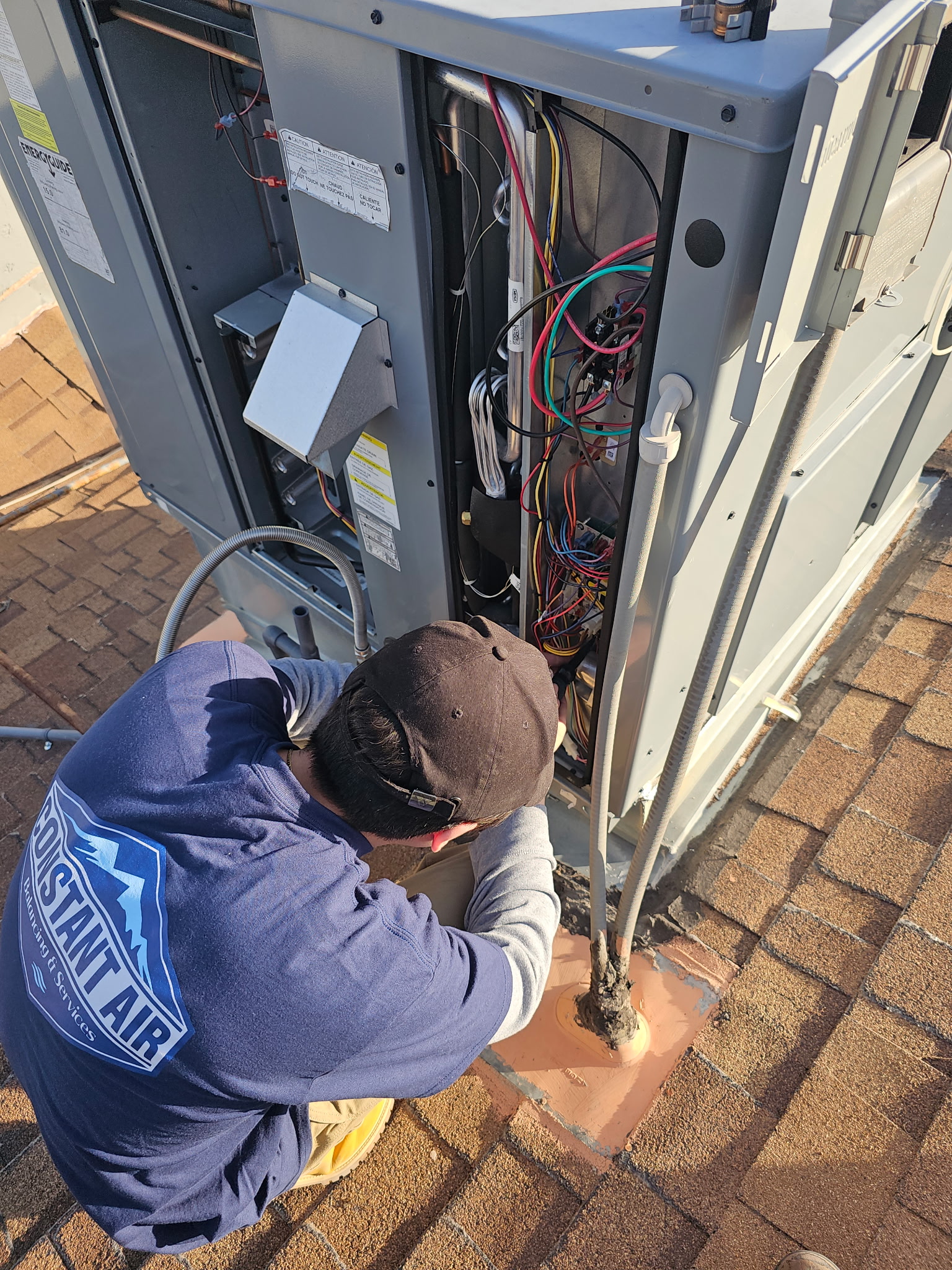
Sloan HVAC repair is shaped by a single environmental factor that valley repair work rarely deals with: airborne gypsum dust from the active mining and processing operation that anchors the community. That dust contaminates condenser coils faster, lands on electrical contactors and creates resistance issues, and shortens evaporator coil life when it gets pulled through return air. Constant Air Balancing and Services repairs Sloan residential and industrial HVAC equipment with a diagnostic-first process that accounts for the gypsum-dust effect and gets the system back to rated performance.
Why Sloan HVAC Repair Looks Different
Sloan HVAC repair is recognizably different from repair work in Henderson, Summerlin, or other valley addresses. The gypsum-dust environment, the elevated industrial process loads on commercial buildings, and the I-15 corridor heat sink combine to put equipment under stress that the standard manufacturer service curves do not fully describe. Repair on a Sloan address starts with a diagnostic that explicitly looks for the symptoms those stresses produce, not a generic checklist run from memory.
The first symptom we look for is contaminated condenser coils. Sloan condensers collect gypsum dust faster than valley condensers, and contaminated coils raise head pressure on the refrigerant loop. High head pressure stresses the compressor, blows capacitors at shorter intervals, and produces the “system runs but does not cool” complaint that brings most Sloan calls to our line. Cleaning the coil alone can sometimes restore performance to rated levels, and that is the first measurement we take after the symptom interview.
The second symptom we look for is electrical degradation on contactors and lugs. Fine dust gets into electrical compartments and creates resistance at contact points. The resistance generates heat. Heat over time chars insulation and pits contactor points. A pitted contactor pulls in late, drops out late, and eventually welds itself in the closed position or fails in the open position. We inspect every Sloan repair call for contactor condition and replace it whenever the points show meaningful pitting, even when it is not the headline failure.
The third symptom is evaporator coil fouling on indoor units that return air through inadequate filtration. Gypsum dust that makes it past the filter ends up coated on the evaporator fins, which insulates the coil thermally and restricts airflow. The system then runs longer to deliver the same cooling, the compressor runs hotter, and the refrigerant superheat reads wrong. Cleaning the evaporator and upgrading the filter to MERV 11 or higher solves both halves of the problem.
The Gypsum-Mining Dust Effect on Cooling Equipment
The US Gypsum operation that anchors Sloan generates fine particulate that the prevailing winds carry across the residential pocket and the surrounding industrial buildings on a daily basis. That particulate settles on every outdoor surface, including HVAC condenser coils. A condenser coil is essentially a tightly packed stack of aluminum fins designed to transfer heat from the refrigerant inside to the outdoor air passing through. When fine dust packs into those fins, three things happen at once: air flow through the coil drops, heat transfer efficiency drops, and head pressure on the refrigerant loop rises to compensate.
Rising head pressure is what damages compressors over time. A compressor rated to operate against a 350 psi discharge pressure does not fail immediately at 425 psi, but it does run hotter, draw more amperage, and age faster. By the time the head pressure climb has been ongoing for 18 to 24 months, the compressor windings have aged out and the unit is on borrowed time. Cleaning the coil twice a year on Sloan installs slows that aging dramatically. We document the coil condition on every Sloan service call.
The dust also gets pulled through return air on indoor units. Standard fiberglass filters at MERV 8 do not capture fine gypsum particulate effectively. The dust passes the filter, settles on the evaporator coil, and over a year or two of exposure builds up enough mass to insulate the coil thermally. We see this on Sloan houses that have not had a coil cleaning in 3 or 4 years: the system runs continuously through summer afternoons and still does not pull the house temperature down to setpoint. The diagnosis is rarely the equipment itself. It is the evaporator coil under a quarter-inch coating of fine dust.
Common Sloan Failure Modes by Season
Sloan HVAC failures cluster by season. Summer failures dominate the call volume. The most common summer call is “the system runs but the house is not getting cool.” Eight times out of ten that call comes back to a contaminated coil, a weak capacitor, or both. Less common but more serious summer failures are compressor lockouts on high head pressure (sometimes a thermal limit trip, sometimes the compressor itself), condenser fan motor failures (often caused by the same dust packing into the motor bearings), and refrigerant leaks at flare connections where thermal cycling has worked the fittings loose.
Spring and fall failures cluster around system startup after a season of disuse. Sloan houses often shut off cooling completely in late October and not turn it back on until late April. When the contactor sits idle for that long with dust on the contact points, the first call for cooling sometimes does not engage the contactor properly. We see “system will not start at all” calls in late spring and early summer that resolve with contactor and capacitor replacement.
Winter failures are less common but include gas furnace ignition issues (often dust on flame sensors or contaminated burner orifices), heat pump defrost cycle failures (control board issues compounded by dust on the reversing valve solenoid), and condensate drain freeze-ups during the few nights a year that Sloan temperatures drop below freezing. Each failure mode has a known set of likely causes, and our diagnostic process narrows from symptoms to cause efficiently because we have repaired these failures before.
Our HVAC Repair Process in Sloan
Every Sloan repair runs through the same documented process whether the address is a residential pocket house or a commercial building. Step one is the symptom interview. We get the complaint, the system age, the last service date, any recent symptoms before the failure, and whether the system shows any error codes or visible damage. That interview narrows the diagnostic before we arrive on site.
Step two is the on-site diagnostic. We measure refrigerant pressures on both sides of the loop, take temperature splits, measure static pressure across the air handler, check electrical draw on every motor, verify capacitor capacitance, and inspect the contactor and condenser coil. Each measurement is documented on the diagnostic sheet given to the owner.
Step three is the repair. We do not swap parts on guesses. If the diagnostic identifies a weak capacitor, we replace the capacitor and re-measure. If it identifies a fouled coil, we clean the coil and re-measure. If it identifies multiple issues (coil plus capacitor plus pitted contactor is a common Sloan combination), we present the owner with the full list and let them choose the scope.
Step four is verification. After the repair we re-run the diagnostic measurements and confirm the system reads correctly. Refrigerant pressures back in their rated band. Temperature split where it belongs. Static pressure within manufacturer limits. The verification is documented on the same diagnostic sheet so the owner has before-and-after numbers.
Cost of HVAC Repair in Sloan
Sloan HVAC repair pricing is itemized so the owner sees what they are paying for. The diagnostic visit is a flat fee set by system type, quoted before we dispatch, and credited toward the repair if the owner proceeds. Capacitor and contactor replacement are the low bracket and price by size and configuration. Coil cleaning is a labor line rather than a parts line, so it prices by system size and access, and an indoor evaporator coil costs more to clean than an outdoor condenser coil because reaching it means opening the air handler.
Condenser fan motor replacement is the middle bracket and prices by horsepower. Refrigerant is billed by the pound. Leak repair labor prices by access and by where the leak turns out to be, which is the widest variable on any quote we write. Major component replacement (compressor, evaporator coil, full TXV) is the expensive end and includes refrigerant recovery and recharge in the number. Commercial rooftop package unit repairs are quoted per scope after the on-site diagnostic.
Synchrony financing is available on larger repair work. We accept all major credit cards, ACH, and check at the property. Quotes are written, not verbal, and they bind us to the price we wrote down. Travel time to Sloan from our Las Vegas shop is built into the diagnostic charge, not billed separately.
Sloan HVAC Repair FAQ
How quickly can you get out to Sloan for an HVAC repair?
For non-emergency repairs we schedule within 1 to 3 business days. For no-cooling emergencies in summer we prioritize Sloan calls and aim to be on the property within 24 hours. The 20-mile drive from our Las Vegas shop is straightforward via I-15, so we can move faster on Sloan than on more remote canyon addresses.
Do you handle commercial rooftop package unit repair for Sloan industrial buildings?
Yes. We repair Carrier, Trane, Lennox, Goodman, Rheem, York, Bryant, Heil, and Tempstar commercial package units in 3-ton through 25-ton sizes. The diagnostic-first process is the same as residential, scaled for commercial component sizes and electrical configurations.
How often should I have my Sloan HVAC condenser coil cleaned?
Twice a year is the recommendation we make to every Sloan customer because of the gypsum-dust load. Spring cleaning gets the unit ready for summer demand. Fall cleaning removes the dust that built up over the summer and protects the compressor through any shoulder-season cooling demand.
What filter should I be running in Sloan?
MERV 11 or higher. Standard MERV 8 fiberglass filters pass fine gypsum particulate that ends up coated on the evaporator coil. Upgrading the filter is the single highest-leverage change a Sloan homeowner can make to extend equipment life and reduce repair frequency.
Will you give a written quote before starting the repair?
Always. We give the diagnostic results in writing, then a written quote for the repair before any wrench moves. You sign approval, the work proceeds at the quoted number, and we re-verify performance with the same measurements after the repair.
Service Area: Sloan, NV
We repair HVAC across Sloan and the surrounding I-15 corridor, including the residential pocket, industrial buildings around the US Gypsum operation, properties along Sloan Canyon National Conservation Area, staff housing, and commercial buildings on the highway service streets. ZIP 89054 is covered in full. The drive runs Las Vegas south on I-15 roughly 20 miles to the Sloan exit.