Paradise AC Repair
The call we get most often from Paradise is some version of the same sentence: the unit runs all afternoon and the place still sits at 80. Sometimes that is a failed part. Often it is a system that was never charged right, or ductwork nobody has touched since the building went up. Constant Air Balancing and Services reads the actual numbers before anyone talks about parts or replacement.

When the Unit Runs All Afternoon and the Room Stays at 80
A system that never shuts off is telling you something specific. It is either moving too little air, carrying too little refrigerant, or fighting a load it was never sized for. Those three look identical from a thermostat and completely different on a gauge set. So the first thing we do on a Paradise call is measure: amp draw at the compressor and the condenser fan, microfarad on the run capacitor, suction and liquid pressures with matching line temperatures, and the temperature split across the coil. Fifteen minutes of readings usually ends the guessing.
Paradise holds some of the most varied housing stock in Clark County, from 1960s apartments to modern condominiums, and the failure patterns track the age of the building more than anything else. In a condo built in the last twenty years the usual answer is electrical: a run capacitor that has drifted out of tolerance, a contactor with pitted points, or a condenser fan motor that gave out after running fourteen hours a day through July. In an older apartment system the answer is more often refrigerant, because the copper has had decades of thermal cycling at the flare joints and the service valves.
Heat makes all of it worse on a schedule you can almost predict. Marginal parts survive a mild May and fail on the first 110 degree afternoon, because that is when the compressor pulls its highest amps and the capacitor has the least margin left. We carry the common failure parts on the truck for exactly that reason: run capacitors, contactors, hard-start kits, condenser fan motors, and universal control boards. A large share of summer repairs end with cold air the same visit instead of a wait on a part order.
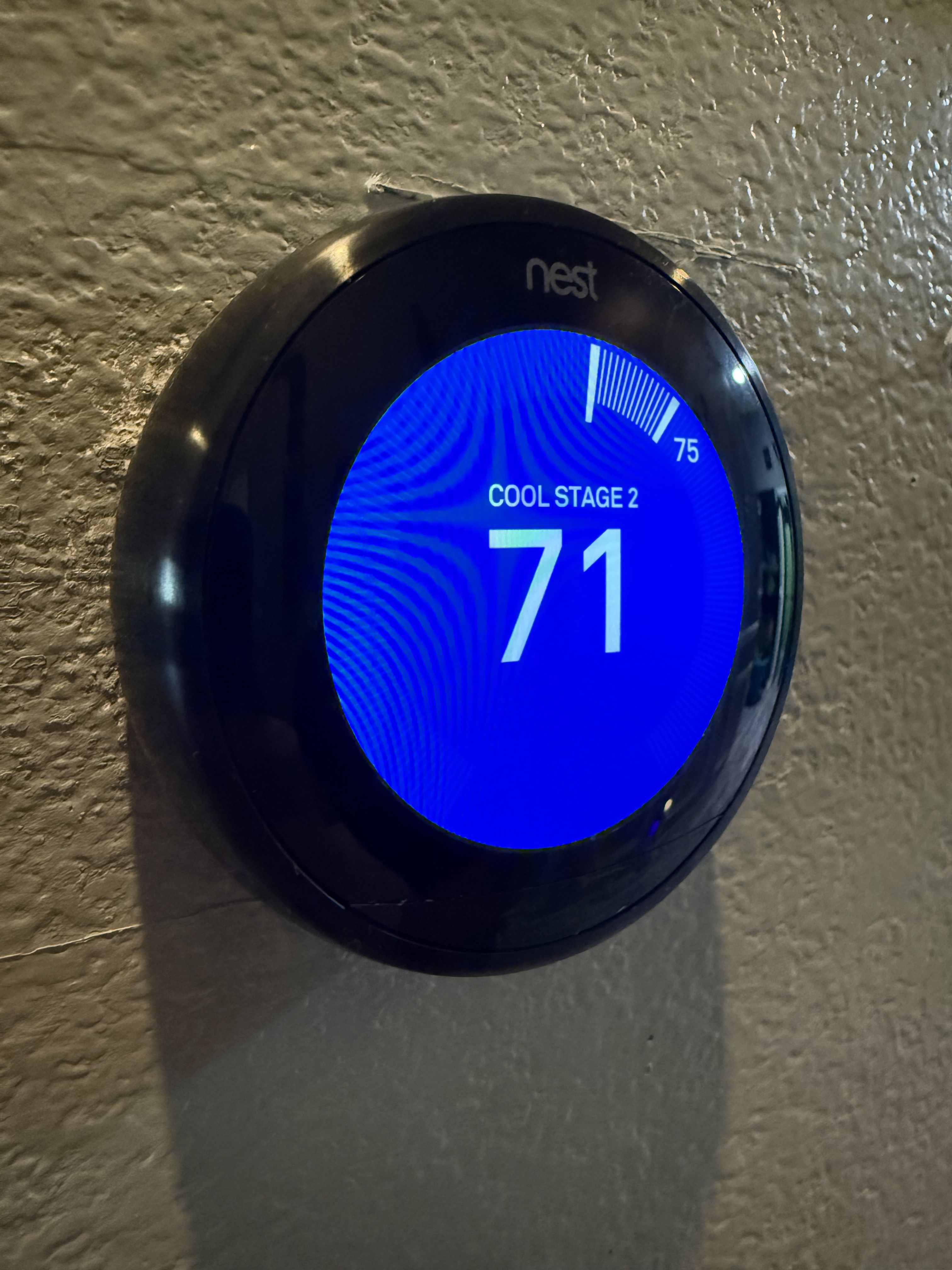
Refrigerant Leaks in Apartment Systems That Predate Most of Us
Plenty of the cooling equipment serving older Paradise apartments has been repaired, re-charged and patched by a long line of people, some careful and some not. When a system like that loses its cooling capacity over a couple of seasons, topping it off is a way of paying for the same problem every year. Refrigerant does not get used up. If the charge is low, it went somewhere.
So we look for where. Line set joints, the service valve cores, the evaporator coil return bends, and the braze points at the condenser are the usual suspects, and each one leaves a signature. An electronic detector finds the active ones, a nitrogen pressure test proves out the quiet ones, and sometimes a dye trace over a few weeks is the honest answer on a slow seep. Finding the leak costs less than replacing refrigerant twice.
The charge itself is the other half of the story. A lot of systems around Paradise were charged by weight off the nameplate, indoors, on a comfortable day, instead of by measuring subcooling against a real load. Half a pound light does not throw a fault code. It just means the coil runs warmer than it should, the compressor works harder every season, and the equipment quits a few years early. When we verify a charge, we verify it against the load the system is actually seeing that afternoon.
On systems that still run R-22 the math changes. What is left of that refrigerant is priced like a scarce commodity, so a leak plus a major part on old equipment usually points toward replacement, while a capacitor or a fan motor on the same system is still worth repairing. We lay both roads out and you pick. Our written quote breaks out parts, labor, and an honest read on what the equipment has left, which is the same document we would want if it were our building.
Rooftop Package Units Along the Paradise Commercial Strips
Cooling a suite off Paradise Road or a storefront near the Strip usually means a package unit sitting on a flat roof in full sun. Those units fail differently than a split system on a house. Everything lives outdoors, so belts, bearings, economizer dampers and contactors all age faster, and a dirty condenser coil on a roof with no shade costs real capacity on the hottest week of the year.
When a rooftop unit stops holding a space, we start with the economizer and the airflow before anyone opens a gauge port. An economizer stuck partly open pulls 110 degree outside air across the coil and no amount of refrigerant fixes that. A filter rack that has not been changed since spring does the same thing from the other direction. Only after airflow checks out do pressures mean anything.
For an ongoing arrangement across multiple units or suites, our Paradise commercial HVAC service page covers maintenance contracts and documentation for property managers. For a single rooftop unit that quit this morning, calling is faster than reading.
Hot house, hot suite, or a unit that quit overnight?
Tell us what the system is doing and we will bring the instruments that answer it. You can also send us the details and we will call you back.
The Point Where Repair Stops Penciling Out
Somewhere past year fifteen, most systems reach a point where each repair buys less time than the one before it. We do not treat that as a sales trigger. We treat it as a math problem you should get to see. When a major component fails on old equipment, we lay out what the repair costs against what the next few years of likely repairs cost, and what a new system would do to the electric bill in a place where the machine runs half the year.
Three things push the answer toward replacement: a compressor or coil failure on equipment well past a decade, an R-22 system with an active leak, and a unit that was undersized or oversized for the space from the beginning. That last one is worth catching before you spend money. A system too large for a condo short cycles, never runs long enough to pull humidity or move air evenly, and wears out its own contactor doing it. Replacing it with the same tonnage repeats the mistake for another fifteen years.
Everything else we repair. A fan motor, a capacitor, a control board, a leaking valve core, a clogged drain, a coil that needs cleaning more than it needs replacing. If the equipment has good bones we would rather fix it and be the people you call next time than close a big ticket once. Twenty-eight years in this valley has taught us which of those two builds a business.
If the answer does come back as replacement, we handle that too, and the Paradise HVAC installation page walks through how we size and commission a new system instead of just swapping boxes. Broader repair work beyond cooling lives on the Paradise HVAC repair page, and our valley-wide AC repair service page covers the same approach across Clark County.
Paradise AC Repair Questions We Get Weekly
My AC runs constantly and the condo still will not cool. What is that usually?
Usually one of three things: low refrigerant from a leak, restricted airflow across a dirty coil or filter, or a charge that was never correct from the day of installation. We check airflow and the temperature split first, then verify the charge against the load the system is actually seeing that afternoon rather than against a nameplate number.
Do you carry common parts, or does everything get ordered?
Run capacitors, contactors, hard-start kits, condenser fan motors and universal control boards ride on the truck, because those are what fail in peak heat. A large share of summer calls end with the system running again on the first visit. Sealed system components and brand-specific boards do have to be sourced, and we tell you that up front.
Can you work on a rooftop package unit for a small business here?
Yes. We service rooftop package units, split systems and ductless equipment for offices, retail, restaurants and light industrial spaces. On a rooftop call we check the economizer and airflow before pressures, because a damper stuck open on a 110 degree day mimics every refrigerant symptom there is.
Why does my system always fail in July and never in May?
Because July is when the compressor pulls its highest amps and a marginal part has the least margin left. A capacitor drifting out of tolerance will carry a mild spring and fail on the first true heat wave. Reading capacitor microfarads and compressor amps during a spring visit catches most of those before they strand you.
Will you push me toward a new system?
No. Replacement gets recommended when the numbers support it: a major component failure on equipment well past a decade, an R-22 system with an active leak, or equipment that was wrong for the space from the start. Anything else we repair. You see the readings and the reasoning before a quote is written.
Should I just have the refrigerant topped off every year?
Refrigerant is not consumed, so a system that needs topping off has a leak somewhere. Paying for the same charge annually costs more over time than finding the leak once. We locate it with an electronic detector, a nitrogen pressure test, or dye on a slow seep, then repair the joint and charge the system properly.
More Paradise HVAC Work and the Areas Around It
Cooling repair is one part of what we do here. If your comfort problem is a room that has never matched the rest of the house, the fix is measurement rather than parts, and the pages below cover that side of the work.
All Paradise, NV HVAC services · See our work · Book a visit
Where We Work in Paradise
We cover Paradise from the Strip corridor east through the neighborhoods around UNLV and Maryland Parkway, and the same trucks run the rest of Clark County. Properties near the Strip sit in an urban heat island that raises cooling demand above what the same equipment would face further out, which is one more reason we measure the load instead of assuming it.