Mount Charleston HVAC Repair
Mount Charleston HVAC repair is cold-climate work. At 7,000 to 9,000 feet in the Spring Mountains, heating dominates the year and the equipment we service is mostly propane furnaces, cold-climate heat pumps, and ductless mini-splits. Snow-impacted outdoor units, frozen condensate, propane combustion drift at elevation, and defrost cycle failures are the failure modes that dominate. Constant Air Balancing brings the right diagnostic tools and the right replacement parts for cabin systems. Call (702) 840-5163 to schedule.
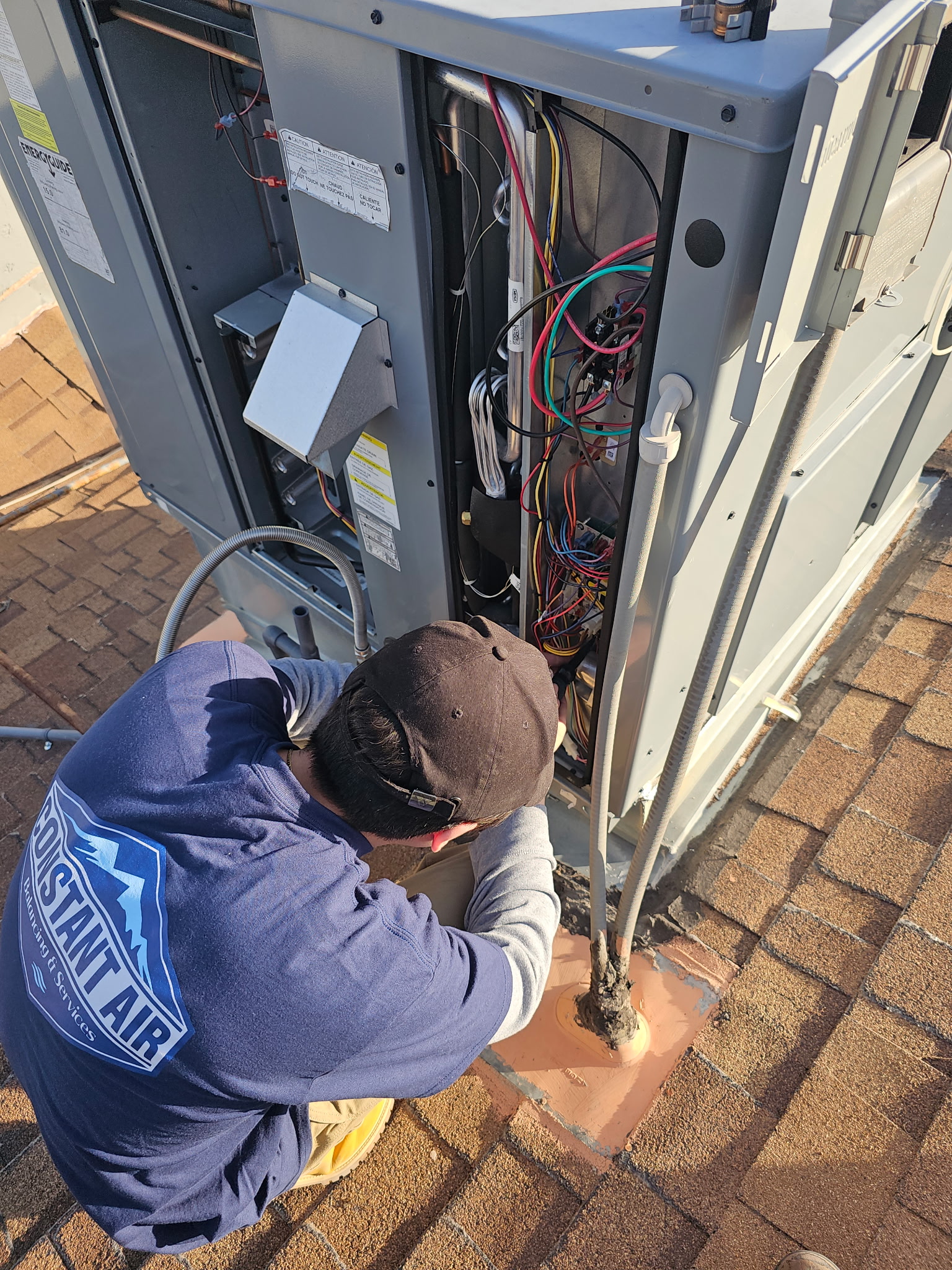
Mount Charleston HVAC Repair: The Brand Standard
HVAC repair on Mount Charleston has a different urgency than valley repair. When a Henderson or Paradise system fails in July, the homeowner is uncomfortable. When a Mount Charleston system fails in January, frozen pipes are 36 to 48 hours away and the cabin becomes uninhabitable. That asymmetry shapes how we approach Mount Charleston service. We carry cold-climate parts inventory year-round (universal igniters, flame sensors, propane gas valves, defrost boards, reversing valves, fan motors, capacitors), we coordinate access during winter storm conditions when road status allows, and we know which short-term workarounds keep a cabin habitable until a full repair can be completed.
The repair philosophy stays diagnostic-first regardless of the urgency. We measure before we recommend: combustion analysis on propane and gas furnaces (high-altitude combustion drifts over time and a quick recalibration often resolves what looks like a failing furnace), refrigerant pressures and superheat/subcooling on heat pumps, defrost cycle operation under real cold-load conditions, air handler static pressure, and electric strip heater amp draw on supplemental backup. Numbers tell us what failed and why. Written diagnostic report on every call.
Constant Air Balancing has serviced Mount Charleston homes for years. We know the local equipment, we know which contractors did the original installs and what shortcuts were taken, and we know the cabin road network from Kyle Canyon Road through Echo Cliff up to the Lodge and across Lee Canyon Road toward the ski area. Familiarity matters at elevation: a Mount Charleston service call is not a job to learn on.
Property Archetypes We Repair on the Mountain
Mount Charleston homes fall into four broad archetypes, each with its own repair profile. A-frame cabins from the 1960s through 1980s typically have propane furnaces (the second or third generation by now) with metal flexible ductwork running through unconditioned attics. Repair patterns: cracked heat exchangers (a serious safety call, replacement-only outcome), failed draft inducers from corrosion, and high static pressure from undersized return ducts in original construction. We carry combustion analyzers and CO meters on every Mount Charleston call because cracked heat exchanger detection is a routine part of the diagnostic.
Ski lodge weekend properties are the opposite operational profile: equipment sits cold for weeks, gets fired up Friday afternoon, runs hard through the weekend, and shuts down Sunday. That thermal cycling is hard on combustion equipment. We see igniter failures, gas valve issues from disuse, and propane regulator freeze-up issues that only appear at the start of a weekend visit. The right repair sometimes includes installing a remote thermostat that pre-heats the cabin starting Thursday evening so the homeowner arrives to a warm interior and the equipment is not asked to recover from a 38 degree cabin in two hours.
Year-round residences (the smaller share of Mount Charleston homes, mostly along Kyle Canyon Road) have higher equipment runtime than weekend properties but lower thermal cycling stress. Their failure modes look more like normal residential HVAC failure patterns: capacitor wear, contactor failure, blower motor fatigue, refrigerant leaks. Cold-climate heat pump installs from the last decade are showing classic defrost cycle issues, which we resolve with control board updates, defrost sensor replacement, or in some cases by replacing the original outdoor unit with a more modern cold-climate model.
New construction (post-2010) tends to have higher-end heat pump or dual-fuel systems with smart controls. Repair on those is often a control or sensor issue rather than a mechanical failure. We service Mitsubishi Hyper Heat, Carrier Infinity, Trane XV20i, and major mini-split brands, and we have the diagnostic tools and software access for each.
Why the 7,500-ft Elevation Zone Matters
At 7,500 feet, atmospheric pressure is about 77 percent of sea level, which has measurable consequences for repair diagnostics. Propane and gas combustion equipment runs leaner at altitude than at sea level for the same gas pressure and orifice size, and over time the combustion calibration drifts as components age. A propane furnace that ran perfectly clean five years ago can develop high CO output or yellow flame issues as the burner ages, even with no visible damage. Combustion analyzer measurement is the only way to catch that drift before it becomes a safety problem, and it is a standard part of every Mount Charleston furnace diagnostic.
Heat pump capacity also varies with elevation. Refrigerant cycle capacity drops because the air mass passing across the coils is less dense, transferring less energy per CFM. That means a heat pump that was correctly sized for the cabin at install can struggle on the coldest days if the coil has any contamination or the refrigerant charge has drifted. We measure refrigerant subcooling and superheat against the manufacturer’s high-altitude charge tables (not the standard valley charts) on every Mount Charleston heat pump diagnostic.
Freezing temperatures also produce failure modes valley systems never see. Condensate drain freeze-up can flood an indoor air handler. Outdoor coil ice accumulation outside the normal defrost cycle window can damage the fan blade. Crank-case heater failures on the outdoor compressor (a small heater that keeps the compressor oil warm during shutdown) can cause refrigerant slugging and compressor damage on startup. All of those are routine on Mount Charleston repair calls and rare on valley calls.
Mount Charleston HVAC repair, cold-climate ready.
Diagnostic-first, cold-climate parts on the truck, combustion-tuned for elevation. Written diagnostic report on every repair call, no surprise pricing.
Equipment Recommendations by Cabin Age
Repair versus replace decisions on Mount Charleston tilt slightly more toward replace than the valley pattern because cold-climate equipment runtime is high and the consequences of mid-winter failure are severe. For 1960s and 1970s A-frame cabins still running original or second-generation propane furnaces with cracked or corroded heat exchangers, the replace decision is usually clear. We recommend a high-efficiency propane furnace with cooling coil added for the summer weeks, or a dual-fuel cold-climate heat pump if the electrical service supports it.
For 1980s and 1990s cabins running 15 to 25 year old propane systems, the math depends on which component failed. A flame sensor cleaning, igniter replacement, or gas valve repair on otherwise sound equipment is worth doing. A control board failure on equipment that old often signals the start of a cascade and we discuss replacement timing.
For weekend ski lodge properties, we sometimes recommend a system upgrade specifically aimed at reducing thermal cycling stress: a programmable or wifi thermostat that pre-conditions the cabin starting Thursday evening, an installer-set lockout that prevents the supplemental electric heat from cycling during shoulder seasons, and refrigerant charge verification on the heat pump. Those upgrades extend equipment life meaningfully on weekend properties.
For year-round homes and post-2010 construction, repair is typically the right call unless the system is approaching design life. We carry control board diagnostics, defrost sensor replacements, and reversing valve service tools to handle the more sophisticated repair calls on modern cold-climate equipment.
Permits, Road Access, and Winter Service Notes for Mount Charleston
Routine HVAC repair calls in Mount Charleston do not require permits. Component replacement (capacitor, contactor, motor, igniter, gas valve, control board, defrost board) is a service repair and proceeds without permit pull. If the repair scope expands to refrigerant line set replacement, evaporator coil change-out, gas line modification, or equipment replacement, a Clark County mechanical permit is required and we pull it as part of the work.
Winter road access is the operational constraint that distinguishes Mount Charleston service from valley service. Kyle Canyon Road and Lee Canyon Road can close during heavy snow events, and Nevada Department of Transportation status determines whether we can reach the cabin on a given day. We monitor NDOT and coordinate with homeowners during winter storms. If a system fails during a closure event, we discuss short-term workarounds (electric space heaters in the most critical zones, faucet drips to prevent freeze, etc.) until road access is restored.
Scheduled non-emergency service is most efficient during the shoulder seasons (May through June and September through October) when road conditions are reliable and equipment can be serviced without weather urgency. We encourage Mount Charleston homeowners to schedule annual heating system maintenance in October so issues surface and get fixed before the first hard freeze. Maintenance includes combustion analysis, refrigerant charge verification, control board diagnostic, and snow-protection inspection of outdoor units.
Mount Charleston HVAC Repair FAQ
Do you do emergency HVAC repair on Mount Charleston in winter?
Yes, when road conditions allow. Mount Charleston is roughly 45 minutes from our shop in good weather and longer during winter storm events. We monitor Nevada DOT road status and coordinate access. If your cabin loses heat during a closure event, we will discuss short-term workarounds to prevent frozen pipes until access is restored.
My propane furnace works but produces a yellow flame. What is wrong?
Yellow flame on a propane furnace usually means incomplete combustion, which produces carbon monoxide. Causes at Mount Charleston elevation include dirty burners, drift in the gas pressure regulator, or a fouled burner orifice. This is a safety call. Stop using the system, ventilate the cabin, and schedule repair immediately. We carry combustion analyzers and CO meters on every Mount Charleston call.
My heat pump runs but the cabin is cold. What should I check?
Most common issues at elevation: low refrigerant charge from a slow leak (heat pumps that worked fine three years ago and now fall behind on cold days are usually low on refrigerant), failed defrost cycle leaving the outdoor coil iced over, control board failure preventing supplemental heat from staging in, or thermostat sensor placement issues. We measure all of these on diagnostic and recommend the right fix.
How much does an HVAC repair diagnostic cost on Mount Charleston?
It is one flat rate for Mount Charleston, quoted before we leave the shop, with a slight premium over valley pricing for the drive. It includes full system measurement: combustion analysis on furnaces, refrigerant pressures and superheat/subcooling on heat pumps, electrical draw, control board status, and defrost cycle verification. The fee credits toward any repair you authorize.
Can you service ductless mini-splits and cold-climate hyper heat pumps?
Yes. We service Mitsubishi Hyper Heat (our most-installed cold-climate line at this elevation), Carrier Infinity, Trane XV20i, and the major mini-split brands. We carry diagnostic tools and software access for each. Modern cold-climate equipment is sophisticated and we have the training to repair it rather than just swap parts.
Other Mount Charleston HVAC Services
View all Mount Charleston, NV HVAC services · See our work · Schedule a repair
Service Area: Mount Charleston, NV
We repair HVAC equipment across all of Mount Charleston, NV including the Old Town cabin neighborhoods, Echo Cliff and Rainbow Subdivision, the Kyle Canyon Road corridor up to the Mt. Charleston Lodge, Lee Canyon Road toward the ski area, and the year-round and weekend residences scattered through the Spring Mountains National Recreation Area. ZIP 89124, in the Spring Mountains National Recreation Area west of Las Vegas.