Paradise Furnace Tune-Up
Your furnace in Paradise works about nine weeks a year and rests the other forty-three. That is the whole problem in one sentence. Equipment that sits still gathers dust on the parts that have to be clean to light, and nobody finds out until the first cold morning. We service heating equipment here in the fall, with a combustion analyzer and a written set of readings, so the unit gets tested while there is still time to fix what the test finds.
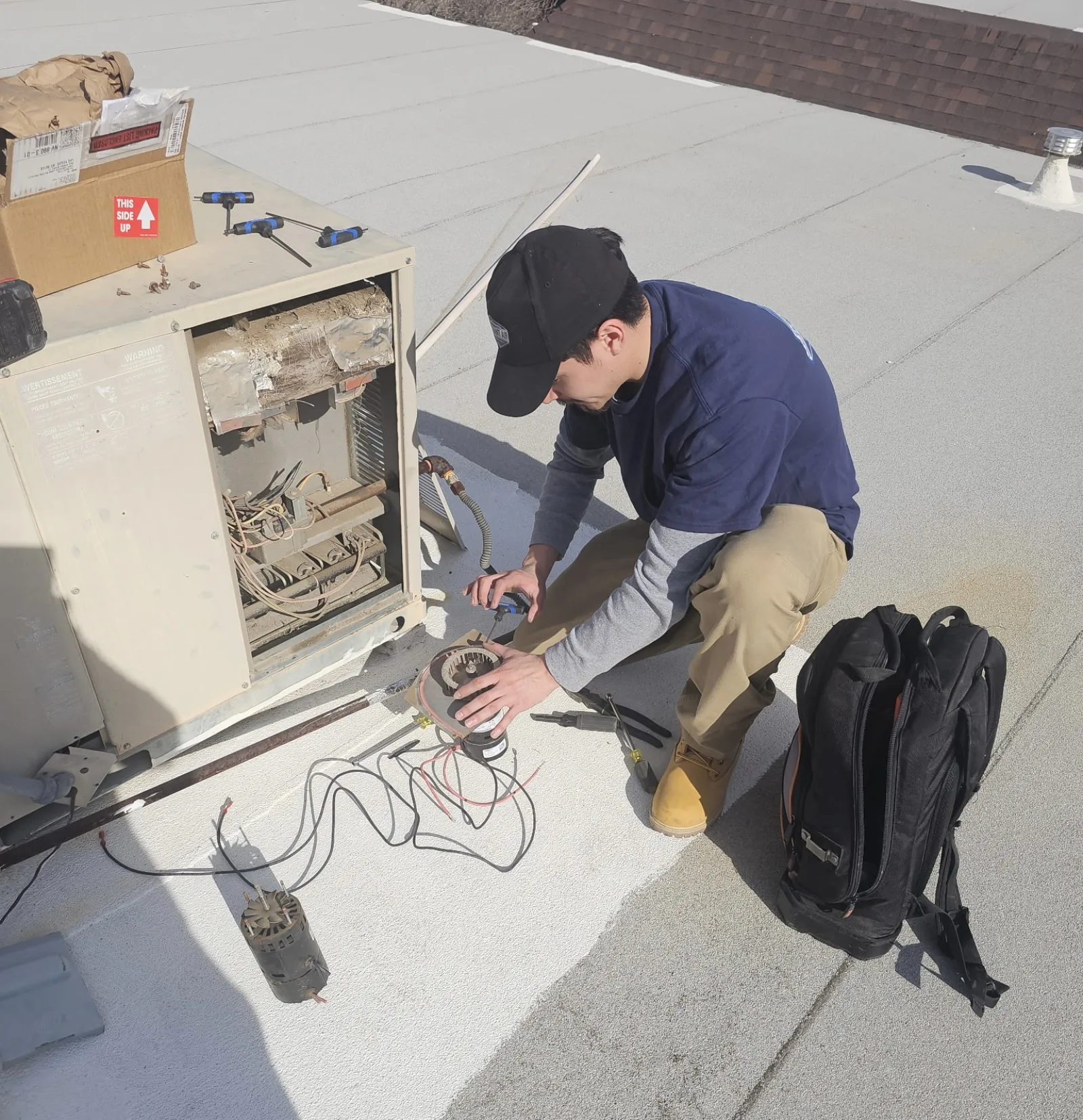
Nine Weeks of Work, Forty-Three Weeks of Sitting
Heating season in this part of Clark County is short enough that a lot of Paradise households treat the furnace as an afterthought. Meanwhile the same air handler has been running cooling since April, pulling desert dust through the cabinet the entire time. When the burner finally gets asked to do something in December, it starts from a resting position that was never as clean as anyone assumed.
Two components take the brunt of that idle stretch. The flame sensor is a thin metal rod that reads a tiny electrical current through the flame; a film of oxidation you could wipe off with a fingertip makes the board think there is no flame at all, and the unit lights and shuts down in a loop. The hot surface ignitor gets more brittle every heating cycle, and the one that survived last February is the one most likely to crack this year. Neither part announces itself.
What We Actually Do at the Unit
The visit follows the same order every time, because the order matters. A burner reading can look perfectly reasonable on a system that is starving for air.
- Ignition sequence, watched start to finishWe call for heat and stand there for the whole cycle. Inducer spins up, pressure switch proves, ignitor glows, gas valve opens, flame sensor holds the flame. A fault anywhere in that chain shows itself in the first ninety seconds if you are actually watching instead of listening from another room.
- Flame sensor and ignitorThe sensor comes out, gets cleaned, and goes back in, and we read the microamp signal to confirm the board is seeing a strong flame rather than a marginal one. The ignitor gets an ohm reading. A resistance that has drifted out of range tells us it is near the end even though it still lights today.
- Combustion analysis and draftThe probe goes in the vent and reads carbon monoxide, oxygen, and stack temperature while the burner runs, and we confirm those gases are leaving the building the way they should. On an older Paradise apartment with an aging vent, this check is the one that matters most.
- Blower, capacitor, and airflowThe motor gets a current reading against its nameplate, the capacitor gets tested rather than eyeballed, and we read what is actually coming out of the supply registers in the rooms that matter. Heat that never reaches the back bedroom is almost never a burner problem.

Combustion Numbers Are Not Optional
Carbon monoxide has no smell and no color, and a gas furnace that is burning badly does not look any different from one that is burning clean. You cannot tell by listening to it and you cannot tell by feeling the air at the register. The only honest way to know is to put a probe in the flue and read what is coming out. That is a five minute test with an instrument, and skipping it is the difference between a real safety check and a sticker on the side of the cabinet.
When a reading comes back wrong we stop and explain what it means before touching anything else. Elevated carbon monoxide in the flue points at incomplete combustion, and that has causes: a dirty burner, a restricted vent, poor draft, or a failed heat exchanger. Telling them apart takes the numbers plus a look inside the cabinet. If a unit is not safe to run, we say so plainly.
Gas Furnaces, Heat Pumps, and Knowing Which You Have
A surprising number of Paradise residents are not sure which kind of heat they own, and the distinction changes the whole visit. If the outdoor unit runs in winter, you have a heat pump. If it sits dead while something indoors makes the warm air, you have a gas furnace. Condominium owners near UNLV are frequently in the first group without knowing it.
On a heat pump there is no combustion to analyze, so the visit shifts to refrigerant pressures in heating mode, the reversing valve, the defrost control, and the auxiliary heat strips. We verify the backup engages when it should, because a heat pump with dead strips feels fine in November and inadequate the one week it gets genuinely cold, and that it is not engaging constantly, which quietly triples what the unit costs to run.
On a gas furnace in a seventies or eighties tract house, the questions are different. Those systems are frequently the second or third piece of equipment to occupy that closet, and what got installed later does not always match the duct that was already there. An oversized furnace on undersized duct short cycles, overheats the exchanger, and wears out early while the far rooms stay cool. Reading the airflow tells us whether equipment and duct are a matched pair, the same measurement work behind a full air balancing visit in Paradise.
If the readings say the system is past saving rather than worth repairing, we say that too. A furnace well into its second decade with a failed exchanger is a replacement conversation, not a repair one, and that is handled through HVAC installation rather than a tune-up. We would rather tell you that in October than have you find out in January. Either way you can send us the details and get a quote before deciding anything.
Book It Before the First Cold Snap
Every heating contractor in the valley has the same calendar problem. October and early November are open. The week after the first genuinely cold night, the phones do not stop.
Booking early buys you a normal appointment window, parts that are actually on the shelf rather than back-ordered because every supply house in Clark County just sold out of the same ignitor, and the option to schedule any repair the visit turns up at a time that suits you. A worn part found in October is an errand. The same part found in January is a cold house and a rushed decision.
Get your Paradise heating system checked while the schedule is still open
Call the office, send us a message, or look through the gallery to see the work we have done across Clark County.
Questions Paradise Homeowners Ask About Heating Service
My furnace barely ran last winter. Does it still need service?
Yes, and the light use is the reason rather than an argument against it. The parts that fail first are the ones that suffer from sitting still: a flame sensor that oxidizes, an ignitor that gets brittle, a blower wheel loaded with dust from the cooling season. None of those care how many hours the burner logged. A fall visit cleans what idling fouls and catches the worn part before the cold morning that exposes it.
How long does the visit take?
Plan on an hour to ninety minutes for one system in a typical Paradise home. Combustion analysis and walking you through the readings adds about fifteen minutes on top of that. A second system in the same building takes roughly the same again. A furnace jammed into a tight apartment closet with no service clearance runs longer, because getting the panel off is half the work.
What happens if you find a safety problem?
We show you the readings and the photos, explain what the numbers mean in plain terms, and tell you whether the unit is safe to run. Elevated carbon monoxide in the flue and a failed heat exchanger both mean the system gets shut down, not worked around. We would rather have an uncomfortable conversation in your hallway than leave a combustion problem running because it was inconvenient to raise.
Do you service heating in apartments and condominiums?
Yes. A good share of Paradise housing is apartments from the 1960s and modern condominiums, and both get serviced regularly. Older buildings often have closet furnaces with tight clearances and venting that has been modified over the decades, so draft and combustion checks carry extra weight there. Newer condominiums are frequently heat pumps, which get a different set of checks entirely.
Why does one room stay cold when the heat is on?
Usually airflow, not the burner. Warm air has to travel the duct to reach that room, and if the blower wheel is loaded, a duct run is crushed or disconnected, or the dampers were never set, the air runs out of push before it arrives. We read the airflow at the register during the visit. If the distribution is genuinely off, balancing the system is the fix, and it is the same work that sorts out uneven cooling in summer.
Should I do this every year?
Annually on anything gas fired, without exception, because the combustion and venting checks are safety work rather than efficiency work. On a newer heat pump with no combustion involved you have a little more room, though we still prefer once a year given how hard the same equipment works cooling through a Paradise summer. If the system has given you trouble before, annual is the honest answer regardless of age.
Where Else We Work in Paradise
Heating is one line on a longer list. Most of our Paradise work is measurement on cooling, ductwork and air quality.
All Paradise, NV services · Furnace tune-up across the valley · See our work · Book a visit
Serving Paradise and the Rest of Clark County
Paradise covers the ground around the Las Vegas Strip, UNLV, and Maryland Parkway, and it holds some of the most varied housing stock in Clark County. Apartments from the 1960s sit a few blocks from modern condominiums, and each one heats differently. We have spent 28 years learning those patterns across every community in the county, and we bring calibrated instruments to a Paradise call rather than a sales pitch.