Paradise Air Balancing
One bedroom sits at 79 while the living room is at 71 and the thermostat swears everything is fine. Nobody needs a new air conditioner for that. They need somebody to put a calibrated hood on every register, write down what comes out, and adjust until the numbers match the rooms. That measurement is what we have built 28 years of work around.
The Hot Bedroom Nobody Can Explain
Every house has one. Back bedroom, corner office, the room over the garage. It runs five to ten degrees off the rest of the place all summer, and the usual advice is to close vents elsewhere, buy a fan, or crank the thermostat down until that one room is survivable and everybody else is freezing. All three are workarounds for a measurement nobody took.
Older Paradise floor plans give us this problem constantly. Construction near downtown often carries original ductwork that has never been properly balanced, which means the system has been distributing air by accident since the day it was commissioned. A run that leaves the plenum at a sharp angle, a branch that is twenty feet longer than its neighbor, a flex duct crushed behind a stored box in the attic, a damper somebody bumped closed during a repair in 2004. Any one of those quietly reassigns air from the room that needs it to the room that already had plenty.
What makes it stubborn is that nothing appears broken. The blower runs, the vents blow, the thermostat reaches its setpoint because the thermostat happens to live in a room getting more than its share. The system is doing exactly what its ducts are telling it to do. Until someone measures the air at each register, there is no evidence to argue with, and no way to know whether the fix is a damper adjustment, a duct repair, or a return that was never large enough.
What the Hood Reads That a Vent Cannot Show You
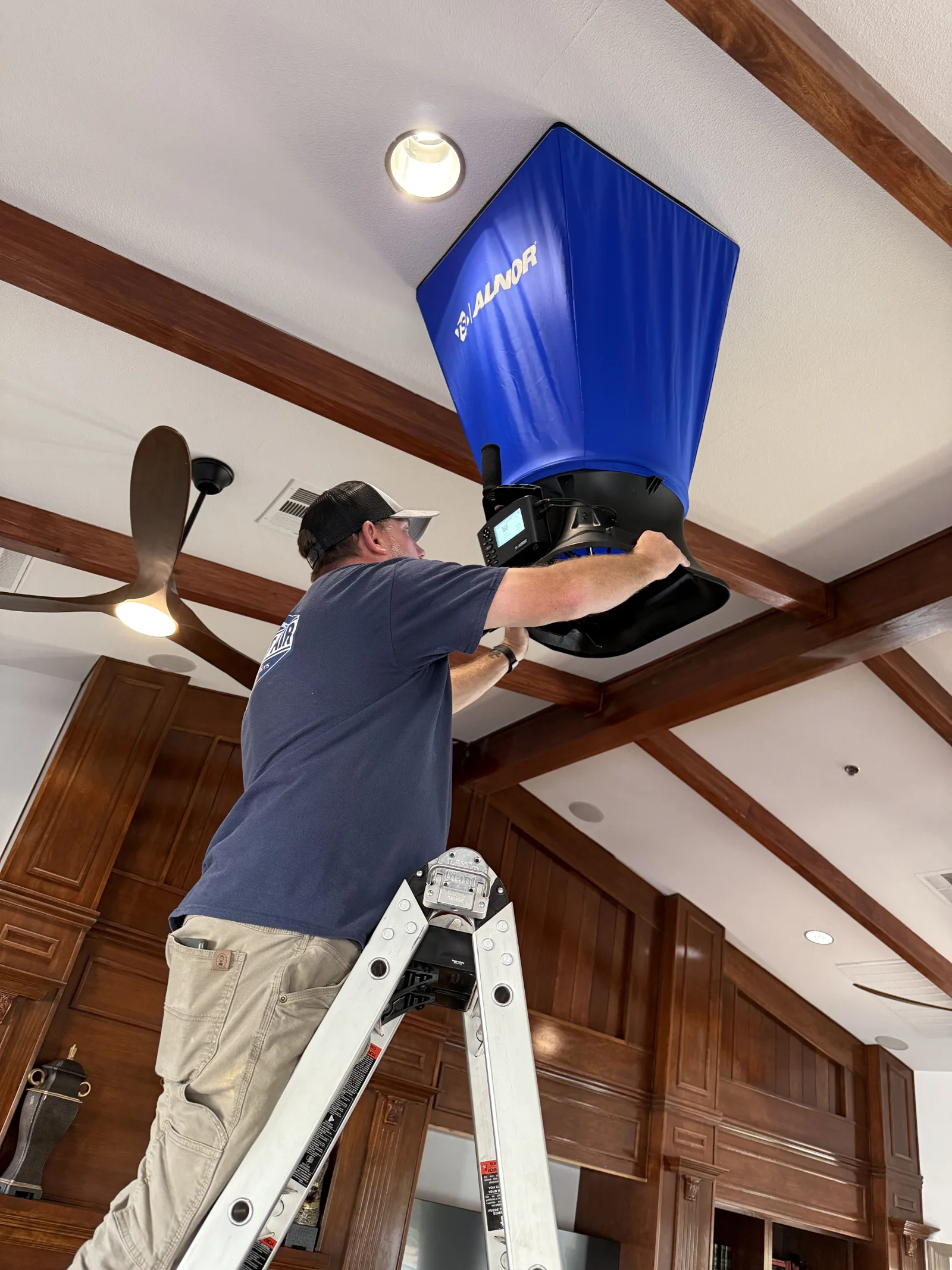
A balancing hood is a fabric cone with a calibrated flow sensor at its throat. It seals over a register and reports how many cubic feet per minute of air are actually coming out. That number is the one thing a homeowner can never get by holding a hand up to a vent, and it routinely surprises people: a register that feels strong can be delivering 40 CFM when the room needs 110, and a register that feels weak can be fine while the room next door is starving.
Airflow alone is not the whole picture, so we read static pressure across the filter and the coil too. High static is the system telling you it is fighting something, usually a restrictive filter, an undersized return, or a coil that needs cleaning, and no amount of damper adjusting fixes a blower that cannot breathe. Total system airflow gets checked against what the equipment is rated to move, because balancing a system that is 30 percent low on total air just redistributes a shortage.

From those readings the fix gets specific rather than general. Sometimes it is balancing dampers at the trunk, opened or closed by measured increments and re-read until the rooms land in range. Sometimes a branch has to be resized or rerouted because no damper setting can push enough air through it. Sometimes the real answer is a return that was never big enough for the tonnage, which shows up as high static and a blower working past its comfortable range. We tell you which of those it is, and the sequence to do them in if it is more than one.
Remodels, Duct Changes, and Systems That Were Never Commissioned
A balance is a snapshot of a system in one configuration. Change the configuration and the snapshot is stale. If a wall came down, a room was added, a ceiling got opened up, or anyone moved, added or capped a duct run, the air that used to serve the old layout is now serving a different one and it does not redistribute itself intelligently. Rebalancing after that work is the step that turns a finished remodel into a comfortable one.
The same applies to equipment changes. A new air handler with a different blower curve does not move air the way the old one did, even at the same nominal tonnage, so the damper positions that worked for fifteen years may now be wrong. Variable-speed equipment is especially worth balancing, because it can quietly compensate for a duct problem by ramping up, which costs you in electricity and noise instead of showing up as a hot room.
Then there is the largest category of all: systems that were never balanced in the first place. Commissioning gets skipped on a lot of construction. The equipment is installed, it produces cold air, the inspection passes and nobody ever measures whether the air landed where the plans said it would. Those systems can run for two decades with one room permanently short, and the owner assumes that is simply how the house behaves.
Questions Paradise Owners Ask Before Booking a Balance
How long does a residential balance take?
For a typical single-family home, most of a day. We measure every supply register and return, read static pressure across the filter and coil, adjust dampers in measured increments, then re-read to confirm the rooms landed where we wanted them. Larger homes, two-story layouts and zoned systems take longer because there are more interacting variables to settle.
Do I get anything in writing when you are finished?
Yes. You get a written report with the airflow reading at each register before and after adjustment, static pressure measurements, total system airflow against what the equipment is rated to move, and notes on anything we found that a damper cannot fix. It is the same document a commercial client would receive.
My duct looks fine in the attic. Can it still be the problem?
Regularly. Flex duct that appears intact can be compressed behind stored items, kinked at a turn, or sagging into long runs that add resistance a rigid duct would not have. Restriction and leakage are both invisible from a walkthrough. The flow hood reading at the register is what proves whether the air is arriving.
We just finished a remodel. Should we balance before or after?
After, once the ductwork is final and the rooms are closed in. Balancing partway through means measuring a system in a configuration that will not exist when you move back in. If the remodel changed duct runs or added square footage, rebalancing is what keeps the new space from stealing air from the rooms that were already comfortable.
Will balancing lower what I spend on cooling?
Often, though comfort is the bigger win. A balanced system lets you hold the thermostat at a reasonable setpoint instead of overcooling the whole house to make one room bearable. When we also find high static from a restriction, correcting it lets the blower move its rated air without straining, which is easier on both the electric bill and the equipment.
Can you balance a commercial suite for a tenant improvement?
Yes, and we do it regularly for spaces near the Strip where a balance report is part of closing out the work. We measure and document each diffuser, set the system to the design airflow, and hand over a report a landlord or project manager can file. Property managers with multiple suites usually put that on a schedule.
Tenant Improvements and Commercial Suites Near the Strip
Commercial work near the Strip and along Maryland Parkway often arrives with a balance report as a deliverable rather than a nice-to-have. Somebody has to demonstrate that each diffuser is moving its design airflow and that the space performs the way the drawings said it would. That is straight NCI-certified work: hood every diffuser, document the readings, adjust to design, re-read, and produce a report the project can close out with.
Occupied suites have their own version of this problem. Conference rooms that empty out cold, workstations under a diffuser that nobody will sit at, a break room that never clears the heat from the equipment in it. Those are usually balance problems dressed up as complaints about the air conditioning, and they are cheaper to solve with a hood and an afternoon than with new equipment.
Book a balance for your home or suite
Tell us which rooms fight you and we will bring the hood and the manometer. You can also send the details and we will call you back.
Related Work Across Paradise
Balancing solves distribution. When the problem turns out to be the equipment itself, or the air the ducts are carrying, these pages cover the rest of it. Our valley-wide air balancing service page explains the method in more depth, and there is more of this work in the project gallery.
Paradise HVAC installation · Paradise HVAC repair · Paradise furnace tune up · All Paradise services · Book a balance
Our Paradise Coverage
We balance homes, condominiums and commercial spaces across Paradise, from the neighborhoods surrounding UNLV out to the Strip corridor, and the same crews cover the rest of Clark County. Twenty-eight years in this valley means we have learned the HVAC personality of each community we work in, and Paradise has more of them packed into one place than almost anywhere else in the county.