Indian Springs HVAC Repair
Indian Springs HVAC repair is a different job from suburban Las Vegas repair work. The town sits at 3,100 feet of elevation along Hwy 95 about 45 miles north of Las Vegas, with homes spread across the Indian Springs Valley Estates subdivision, Creech AFB civilian housing, and small commercial properties near the gate. Every repair we run here starts with a real diagnostic, then a fix that lasts.
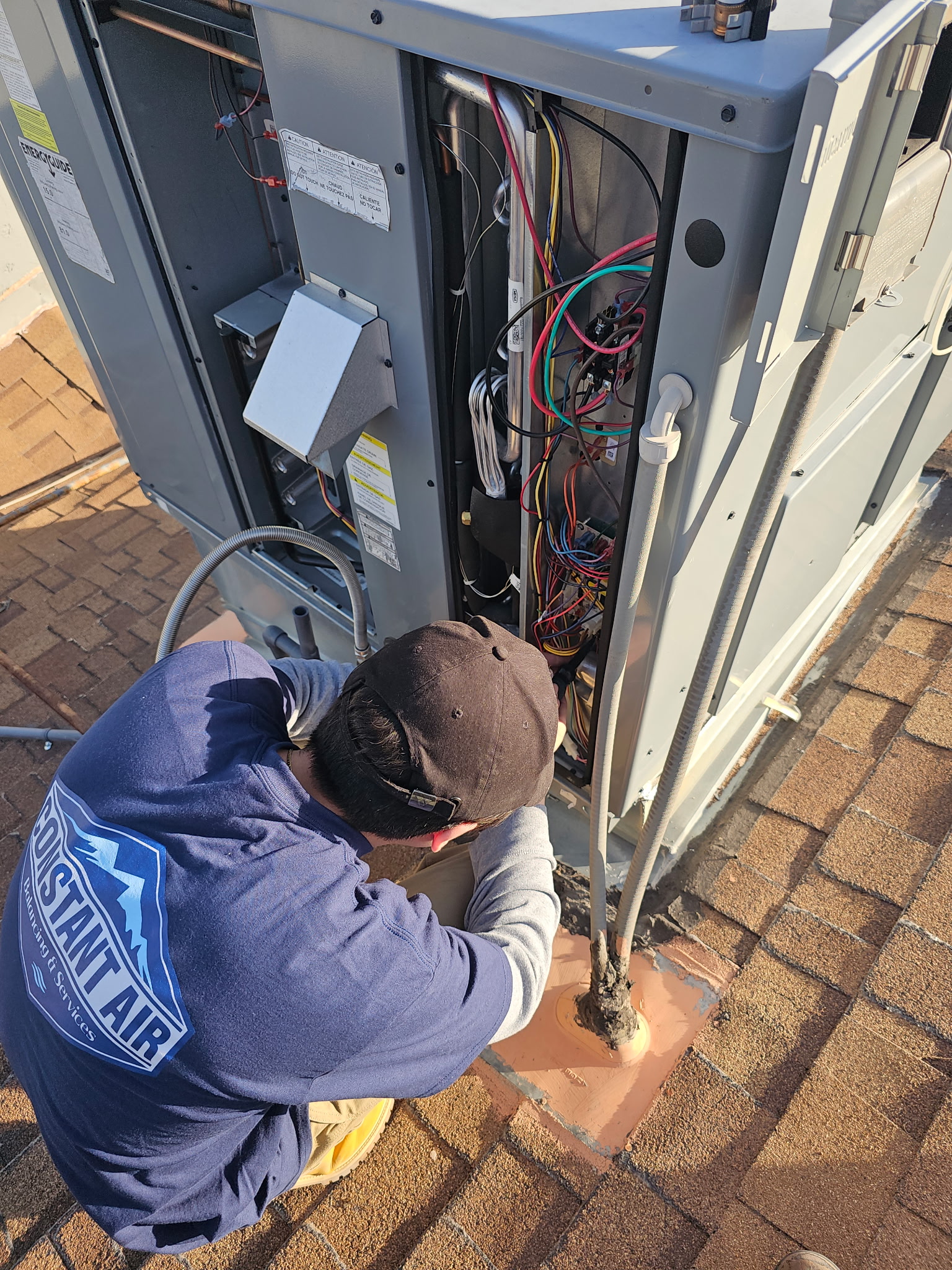
The Indian Springs Case for HVAC Repair
The case for HVAC repair in Indian Springs is straightforward: a properly diagnosed and corrected repair often extends equipment life by 5 to 8 years and costs a fraction of full replacement. The trick is doing the diagnostic correctly the first time so the repair actually fixes the problem instead of masking it. Our standard on every Indian Springs service call: pressures (suction, head, subcooling, superheat), electrical readings (capacitor microfarads, compressor amps, contactor pull-in, condenser fan motor amps), airflow and static pressure on the indoor blower, and combustion analysis on gas furnaces during heating-season calls.
Those measurements get written down, so if a part is replaced, the failed reading is the documentation for why. That approach matters here because Indian Springs is far enough off the Las Vegas service grid that some companies treat it as a profit center for quick parts swaps that do not last. We do not. Our repair work is the foundation for the next decade of equipment operation, and we want the system to keep running long after we leave the property.
The other consideration on Indian Springs repair calls is the round-trip distance from our Las Vegas shop. We stage extra inventory on Indian Springs dispatches so the tech rarely needs a second trip for a common failure. That saves the homeowner time and saves us a wasted drive up Hwy 95.
High-Desert Elevation Impact on Equipment Life
Indian Springs sits at 3,100 feet, which is about 1,000 feet higher than the Las Vegas valley floor. That elevation has measurable effects on HVAC equipment life and on the repair calls we get. Lower air density at elevation means condenser fans move slightly less mass per revolution, so motors work marginally harder to deliver rated airflow, which over years compounds into bearing wear and motor burnout. Indian Springs also sees a wider daily temperature swing than Las Vegas because the surrounding desert radiates heat faster after sunset, so equipment cycles through expansion and contraction more aggressively, stressing refrigerant joints, brazed connections, and electrical terminations.
Winter is genuinely harder on HVAC equipment in Indian Springs than in Las Vegas. Overnight lows drop into the high 20s regularly and occasionally into the teens during cold snaps. Heat pumps run more defrost cycles per winter, which stresses the reversing valve and the defrost board. Gas furnaces run more hours per winter, which means flame sensors foul faster, igniters age faster, and combustion-related wear accumulates. We see these failure patterns on Indian Springs repair calls more often than on equivalent-age Las Vegas systems, and we stock the parts to fix them on first visit.
Blowing dust off the open desert along Hwy 95 loads outdoor condenser coils with a fine grit that conventional fin-comb cleaning misses. We use a coil cleaner and water rinse on every service call where the outdoor unit is more than three years old, because a fouled coil drives head pressure up, drives compressor amps up, and shortens compressor life. Cleaning is a 20-minute task that delays the next compressor failure by years.
Equipment and Parts We Keep on Indian Springs Service Calls
Inventory on Indian Springs service trucks is deeper than on a typical Las Vegas dispatch because the round-trip cost of a missing part is too high to risk. We carry capacitors in common microfarad ratings (40/5, 45/5, 50/5, 55/5, 60/5, 70/5), contactors in 1-pole and 2-pole 30A and 40A configurations, condenser fan motors in PSC and ECM configurations for the brands we see most often, blower motors in common HP ratings, run capacitors, dual-run capacitors, hard-start kits, and a working stock of refrigerant in R-410A and R-454B with R-22 available on request for older systems.
On the gas-furnace side we carry flame sensors, igniters (hot surface and silicon nitride), inducer motors, pressure switches, gas valves for the most common brands, and combustion analyzers calibrated for high-altitude operation. On the heat-pump side we carry reversing valves, defrost boards, sensor packs, and the diagnostic equipment to read the manufacturer fault codes on the major brands. We do not promise we will have every possible part for every possible brand, but the common-failure inventory covers about 90 percent of Indian Springs service calls on first visit.
Indian Springs HVAC repair, done right the first time.
Diagnostic-first repair. Real measurements, written quote, fix what is actually broken. Scheduled service runs from Las Vegas.
Process from Diagnostic to Verified Repair
Every Indian Springs repair call runs through the same sequence regardless of the failure mode. Step one is the customer interview: what failed, when, what changed in the days before the failure, any prior repair work on the system. Step two is a visual inspection of the equipment: signs of corrosion, refrigerant oil residue indicating leaks, scorched electrical terminations, water damage on furnace cabinets, dust loading on coils. Step three is the measurement set described earlier: pressures, electrical, airflow, combustion. Step four is the diagnosis, which is a written list of failed components keyed to the measurements that prove the failure.
Step five is the written quote. The quote shows the parts cost, the labor cost, and any associated work (refrigerant top-off, coil cleaning, condensate clearing) that we recommend at the same visit because doing it now is cheaper than coming back for it later. Step six is the repair itself, performed with proper procedure: brazing under nitrogen on any refrigerant work, evacuation to 500 microns on system openings, weighed-in refrigerant charge verified by superheat and subcooling. Step seven is verification: the same measurements taken before the repair, retaken after, with the corrected values written on the invoice as proof the repair restored the system to spec.
That sequence takes longer than the typical Las Vegas valley quick-swap repair. We are honest about that. The trade-off is that the repair lasts. Most of our Indian Springs repair customers come back to us for the next service call because the work held up.
Cost of HVAC Repair in Indian Springs
Repair pricing in Indian Springs depends on the component, the brand, and the labor complexity. Capacitors and contactors are the low end. Motors are the middle, and both condenser fan motors and blowers price by horsepower and by whether the system takes an ECM or the older PSC. Control boards price by brand. The high end is anything inside the refrigerant circuit: a TXV, a leak repair that has to be chased and brazed and then recharged, or a compressor, which prices by tonnage and brand and is usually the point where replacement enters the conversation. The dispatch fee is flat, quoted before we send a truck, and credited against approved repair work.
We provide a written quote before any repair work begins. No work happens on a verbal quote. If the homeowner declines the repair, the dispatch fee covers the diagnostic visit and the system is left in safe condition. The travel time to Indian Springs from Las Vegas is included in the dispatch fee; we do not bill mileage as a line item.
Top Indian Springs HVAC Repair Questions
How fast can you get to Indian Springs for an emergency repair?
Typical emergency dispatch to Indian Springs is 60 to 90 minutes from the time of the call, depending on Hwy 95 traffic. We are honest about that on the phone rather than promising a 30-minute response we cannot deliver. Scheduled service is booked the next business day for non-emergency calls.
Do you charge a separate trip fee for Indian Springs?
Travel time is built into the flat dispatch fee, which you see before we send a truck. We do not bill mileage as a separate line item on the invoice. The dispatch fee is credited against the repair cost if you approve the work.
What brands of HVAC do you repair in Indian Springs?
Carrier, Lennox, Trane, Goodman, Rheem, American Standard, York, Day & Night, Bryant, Amana, ICP, and Mitsubishi mini-splits. We carry inventory for the brands we see most often in Indian Springs so the tech does not have to make two trips for a common repair.
Why does my Indian Springs HVAC need more frequent service than my friend’s in Vegas?
Elevation, temperature swings, and blowing dust off the open desert all stress equipment harder here than in suburban Las Vegas. Heat pumps run more defrost cycles per winter, condenser coils foul faster, and the wider daily temperature swing stresses refrigerant joints. We recommend annual service in spring and fall to catch wear before it becomes a failure.
Do you handle warranty claims for Indian Springs systems still under warranty?
Yes. We register the failure with the manufacturer, document the diagnostic readings, submit the claim, and coordinate the warranty-part delivery. Most major brands cover parts for 10 years on the original purchaser. We bill the homeowner only for diagnostic labor and installation labor not covered by warranty.
Other Indian Springs HVAC Services
View all Indian Springs, NV HVAC services · See our work · Get a free quote
Service Area: Indian Springs, NV
We repair HVAC across all of Indian Springs, NV including the Indian Springs Valley Estates subdivision, neighborhoods along the Hwy 95 corridor, Creech AFB civilian housing nearby, properties at the Mt. Charleston turn-off, the small commercial strip near the gate, and homes inside ZIP 89018. Scheduled service runs from Las Vegas, with same-week booking for non-emergency repairs.