Spring Valley Commercial HVAC Service
Spring Valley runs on small commercial space: hundreds of restaurants, bakeries and hot pot kitchens along the Spring Mountain Road corridor, salons and karaoke rooms in the same strip centers, medical suites around Spring Valley Hospital, and light industrial off Arville. We work on the rooftop units, ductwork and makeup air that keep those spaces open, and we read airflow before we reach for equipment.
Rooftop Units on 1980s and 1990s Strip Centers
Most commercial HVAC in Spring Valley is a package unit sitting on a flat roof over a tenant bay, usually somewhere between three and fifteen tons, usually Carrier, Trane, Lennox or York. A lot of those curbs were set when the center was built in the late eighties or the nineties, and the equipment has been swapped once or twice since. What has not changed is the roof itself and everything the Mojave sun does to it.
Thirty summers of ultraviolet and 160 degree roof surface chalk the cabinet paint, harden the panel gaskets until they no longer seal, crack the flex duct connections at the curb, and bake the wire insulation inside the control compartment until it goes brittle. Blown dust from the west side of the valley packs into condenser coils and cuts heat rejection, which shows up as high head pressure long before it shows up as a warm dining room. Economizer linkages are the other reliable find. The damper motor gave out years ago, nobody noticed, and the unit has been pulling 110 degree outside air or none at all ever since.
When we take on a Spring Valley roof, the first visit is a survey rather than a repair. We open every unit, read the nameplate against the actual electrical draw, check refrigerant performance, look at the curb and the duct drop, and note which cabinets are close to done.
When the Hood Pulls More Air Than the Building Gets Back
This is the call we get most often from Chinatown kitchens. The dining room will not cool, the front door takes a real pull to open, the door gasket whistles, and smoke rolls out from under the hood instead of going up it. The owner has been told the rooftop unit is too small. Usually it is not.
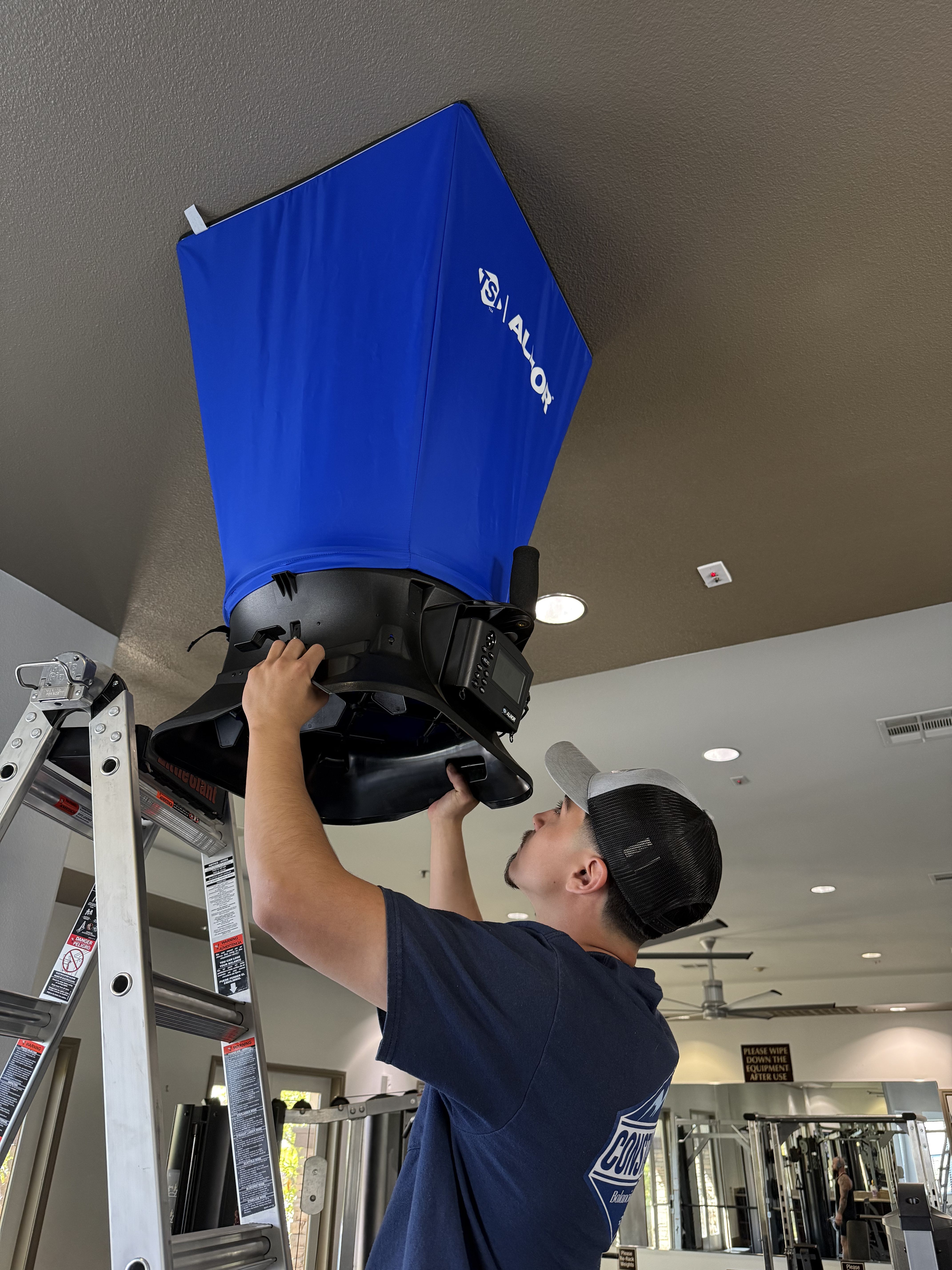
A commercial hood exhausts a large volume of air out of the building every minute it runs. Something has to replace that air. If the makeup air unit is undersized, switched off because it blows warm, or was never installed when a retail bay was converted to a kitchen, the building goes negative and pulls its replacement air through the front door, the ceiling, and every gap in the envelope. That incoming air is unconditioned, so the air conditioner is trying to cool the whole outdoors through a doorway. Adding tonnage does not fix that. We measure hood exhaust, measure what the makeup air unit is actually delivering, read building pressure against outside, and close the gap. Read more about Spring Valley air balancing if that sounds like your kitchen.

Grease Changes the Service Interval
A roof over a barbecue kitchen or a hot pot house should not be on the same service schedule as a roof over an insurance office. Grease-laden exhaust leaves a film on everything downwind of the exhaust fan. It collects on the condenser coil of the neighboring package unit, on the fan blades, on the roof membrane, and inside any return path that runs near the kitchen. A coated coil rejects less heat, head pressure climbs, and the compressor works harder every hour it runs.
Inside the space, filters load faster than the calendar suggests. A filter that would last a quarter in a retail suite can be loaded in weeks over a fryer line, and a loaded filter raises static pressure, drops airflow across the evaporator, and starts the whole chain over again. On a kitchen account we settle on a filter type and change interval that match the cooking, and wash coils on a schedule that matches the grease rather than the season. Where a suite needs more than a filter change, our Spring Valley indoor air quality work covers the filtration and ventilation side.
Suites That Changed Use and Were Never Resized
Spring Valley strip centers turn over. A bay that opened as a dry cleaner becomes a bakery. A retail space becomes a dental office. The tenant improvement puts up walls and a drop ceiling, and the mechanical system stays exactly what it was, sized for a load and a floor plan that no longer exist. That is why one room in a suite sits at 80 degrees while the room next to it is cold, and the rooftop unit runs all afternoon chasing one thermostat.
Medical and dental suites near Spring Valley Hospital are where this matters most, because in a clinic the relationship between rooms is part of how the space works. An operatory, a sterilization room, a lab and a waiting room are meant to sit at different pressures relative to each other, and filtration has to be right for the equipment in the room. We measure what each room is actually getting, set the supply, return and exhaust so the rooms hold the relationships the practice is designed around, and give you the readings in writing. If the equipment itself is the limit, Spring Valley HVAC installation is the next conversation.
A Dozen Suites on One Roof
Property managers running a Spring Valley center, an apartment community, or a self storage and light industrial building off Arville have a different problem than a single tenant. Nobody knows which unit feeds which suite until something fails, and every tenant call arrives as an emergency. We start by mapping the roof: each unit tagged, matched to its suite, with age, capacity and condition recorded. From there the schedule and the replacement budget both get easy, because you can see which cabinets are close instead of finding out in August.
Scheduling is built around your tenants rather than ours. Restaurants get pre-open or after-close work, because a kitchen cannot lose a lunch service to a technician standing in the aisle. Most rooftop work never touches the occupied space at all, and when it does we set the window with you first. Notes go in the file the same day. For single system breakdowns, see Spring Valley HVAC repair or Spring Valley AC repair.
Get a Spring Valley roof looked at before the heat does it for you
Call, or send us the address and suite count and we will schedule a walk of the roof.
Questions Spring Valley Owners Ask Us
My dining room never cools. Do I need a bigger unit?
Probably not, and we would rather measure before you spend on tonnage. The usual cause is that the hood exhausts more air than the makeup air unit puts back, so the building runs negative and drags hot outside air in through the front door. If the tonnage really is short, the numbers will say so.
Why is the front door so hard to open?
That pull on the door is the building telling you it is short of air. The exhaust fans are winning against everything coming in. You will usually see cooking smells drifting into the dining room and a hood that spills smoke as well. It is a balance problem and it is fixable without new equipment in most cases.
How often should a rooftop unit over a kitchen be serviced?
More often than one over an office. Grease film builds on condenser coils and fan blades, and interior filters load in a fraction of the time. We set the interval to the cooking rather than the calendar, which usually means more frequent filter changes and a coil wash schedule that keeps head pressure where it belongs.
We converted a retail bay into a clinic. Is the old system enough?
It depends on what the conversion added, and it is worth checking rather than assuming. New walls change how air needs to move, and a clinic asks the system to hold different pressures between rooms. We measure each room, tell you what the existing equipment can and cannot deliver, and set the airflow accordingly.
Can you work outside our business hours?
Yes, and for restaurants we prefer it. We schedule before opening or after close so you do not lose a service. Most rooftop work happens above the ceiling and never touches your floor anyway. Anything that does affect the occupied space gets scheduled with you in advance.
Do you handle a whole center rather than one suite?
Yes. We map the roof, tag every unit to its suite, record age and condition, and build one schedule across the property. Owners and managers get a written record after each visit so replacement planning is based on measured condition instead of guesswork.
Do you also service the heating side?
Yes. Package units in Spring Valley carry gas heat that sits idle most of the year and then gets asked to work on the first cold morning. We check heat exchangers, ignition, gas pressure and safeties on the same visits. See Spring Valley furnace tune ups for the heating side on its own.
Other Spring Valley Services
All Spring Valley, NV HVAC services · See our work · Send us the details
Where We Work in Spring Valley
We cover Spring Valley from the Spring Mountain Road corridor and Chinatown east toward the Strip, south through the Rainbow, Jones and Durango commercial frontages, and out to the Arville and Polaris industrial pockets, including the medical offices around Spring Valley Hospital.