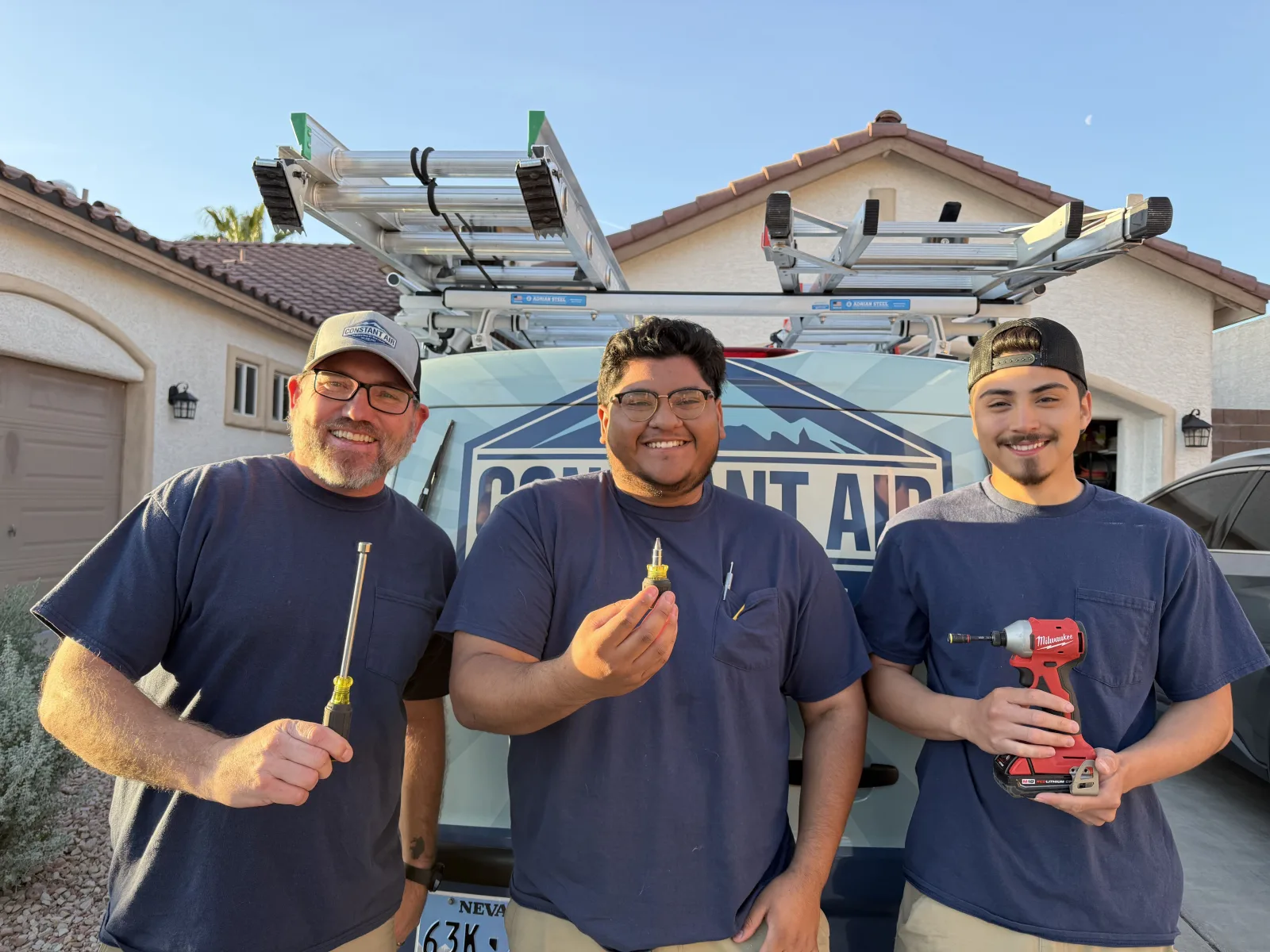
Every tool on a Constant Air roof exists to produce a number. Manometers for pressure, hoods and anemometers for airflow, gauges and probes for refrigerant, a meter for electrical, a camera for what the eye misses. If a tool cannot tell us something measurable about your system, it stays in the van. That is what our National Comfort Institute certification actually means in practice.
People ask what is in the bag. Fair question, because on a lot of service calls the bag never really opens. A technician looks, listens, offers an opinion, and writes it up. We work differently, and the tools are the reason.
Here is what goes up on a Paradise roof with our crew, roughly in the order it gets used, and what each one answers.
The Manometer, Which Goes On First
A digital manometer reads pressure differences, and on an HVAC system pressure is the vital sign. We drill or use existing ports to read static pressure on both sides of the air handler, across the filter and across the coil. Those readings tell us whether the blower is fighting resistance the system was never designed to carry.
The reason this goes first is that almost everything downstream depends on it. A system running high static is moving less air than its nameplate says, and if you do not know that, every refrigerant reading you take afterward is going to mislead you. A coil starved for air behaves like a coil with a charge problem. Plenty of systems have been charged twice by technicians chasing symptoms that a manometer would have explained in four minutes.
The manometer also tells us where the resistance is, because we read at multiple points. A high drop across the filter is a filter problem. A high drop across the coil with a clean filter is either a dirty coil or a coil too small for the airflow. A high total with normal component drops points at the duct itself, which moves the investigation into the attic.
The Balancing Hood and the Anemometer
Pressure tells us how hard the system is working. Airflow tells us what is actually arriving. The calibrated flow hood seals over a register and reads the volume coming out of it in cubic feet per minute, so we can compare room by room and against what the equipment should be delivering in total.
The handheld anemometer covers what the hood cannot. Some registers are too tall to hood, some are in a soffit, some are in commercial ceilings where the diffuser geometry does not suit a hood skirt. The anemometer reads air velocity at a point, and with the free area of the grille it gets us to a volume. Neither instrument means anything uncalibrated, which is why calibration is part of how we maintain them rather than an afterthought. Both are the backbone of our air balancing work and both produce numbers that go into the written report.
Gauges, Probes, and the Thermometers That Go With Them
Refrigerant work gets a bad reputation because it is done badly so often. Hooking up gauges and topping off a system that reads low is the single most common way money gets wasted in this trade. A system that is low is a system that leaked, and it will leak again.
What the crew carries for this is a manifold or wireless probe set plus accurate temperature clamps. You cannot judge a charge from pressure alone. You need suction and liquid pressures, suction line temperature, liquid line temperature, and the air temperatures entering and leaving the coil. Out of those come superheat and subcooling, which is where the real answer lives. On a 110-degree Paradise afternoon on a hot roof, temperature readings drift if you rush them, so the clamps stay on until the numbers settle rather than until somebody gets impatient.
Alongside that goes a leak detector and dye, because finding the leak is the job, and a good vacuum pump and micron gauge for any system that gets opened. Pulling a proper vacuum is invisible work that nobody sees and everybody feels three years later.
The Electrical Side
A clamp meter and a decent multimeter answer the questions that come up on the hottest days. Capacitors sag before they fail outright, and a capacitor reading well under its rated value will start a compressor fine at nine in the morning and refuse at four in the afternoon. Measuring it takes a minute and settles the argument.
Contactors get inspected and tested too. Their contacts pit and burn over years of cycling, and a pitted contactor drops voltage under load in a way that is hard to see and easy to measure. Running amps on the compressor and condenser fan get compared to the nameplate, because a motor drawing high amps is telling you about a bearing or a coil long before it quits.
Also in the pouch: a non-contact voltage tester and lockout hardware. Nobody on our crew opens a disconnect on a Paradise commercial roof without proving it is dead.

The Things That Are Not Instruments
Some of the gear has nothing to do with measuring, and leaving it behind costs the customer a second trip. Duct mastic and mechanical fasteners so a leak found in the attic gets sealed the same day. Common capacitors and contactors on the truck so a failure on a hot afternoon does not become an overnight wait. A borescope for looking inside a plenum or down a duct run without cutting it open. A thermal camera, which is not a diagnosis by itself but is very good at showing where a duct is dumping cold air into an attic.
Plus the unglamorous part: roof-safe footwear, water, shade, and gloves that survive metal that has been in the sun since ten in the morning. A technician who is cooking on a roof rushes, and rushed readings are wrong readings. On commercial HVAC service calls where units sit on a white roof with nothing above them, that matters more than it sounds.
Questions About How We Work
Why does your technician spend so long before touching anything?
Because the first twenty minutes decide whether the next two hours are useful. Pressure and airflow readings come before any part gets replaced, so the repair addresses the cause instead of the symptom. It feels slow and it saves return visits.
Do you charge to take measurements?
Diagnostics are part of the service call, and you get the readings whether or not you hire us for the repair. What we will not do is guess for free and then sell you a part, because that is how people end up paying twice for the same problem.
Can I see the readings you took?
Yes, and you should ask for them from anyone. We write down static pressure, register airflow, temperatures and electrical values, and on balancing work you get a written report. It is your record for the next time somebody works on the system.
The Short Version
The tools are not there to look impressive on a roof. Each one closes a question that would otherwise be answered with a guess. If you want to know what is actually happening in your system, have somebody bring instruments.
Get Real Numbers on Your System
NCI-certified technicians with calibrated instruments on every Paradise call, residential and commercial.
Free Quote (702) 840-5163