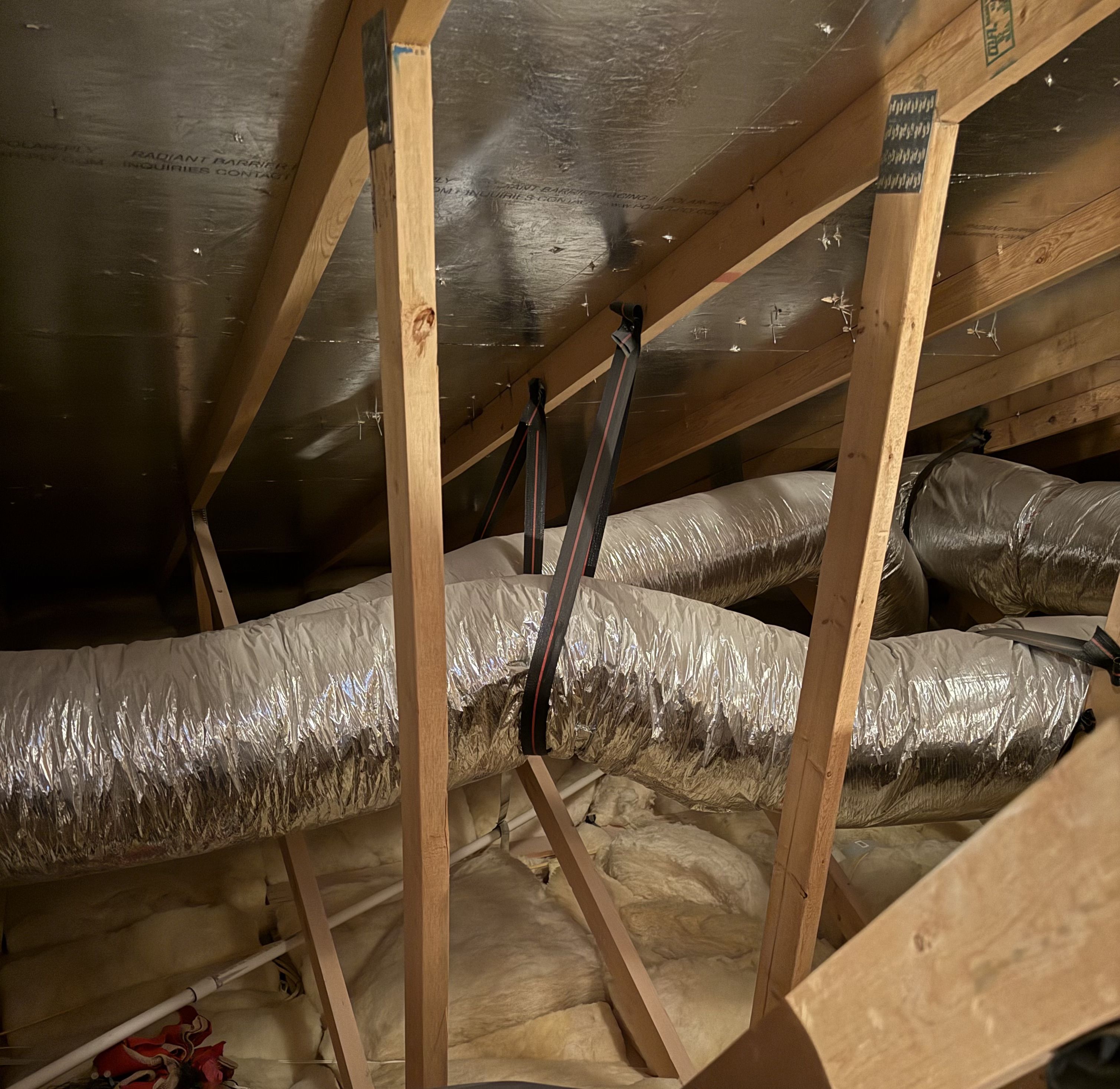
Short versionIn a typical Spring Valley tract house, the air handler and nearly all the duct sit in an attic that runs far hotter than the outdoor air on a July afternoon. That one fact explains warm supply air, dusty registers, weak back bedrooms and surprise ceiling stains. Most of the cure is duct and drainage work, not new equipment.
Half of Your Air Conditioner Lives in the Hottest Part of the House
Two story stucco, concrete tile roof, slab foundation, no basement, and the air handler sitting on a plywood platform between trusses above a hallway. Nobody put it there to punish you. Short mechanical closets and tight lots made the attic the cheapest place to park a large metal box, and builders across the valley made the same call for thirty years.
Under tile at three in the afternoon in July, we routinely read attic temperatures in the 130s and 140s, and higher near the ridge above the insulation line. The blower cabinet, the coil housing, the supply plenum and every foot of flex feeding your bedrooms are soaking in that. So is the drain pan, the low voltage wiring and the control board. Once you accept that, a long list of complaints that look unrelated turn out to be the same story told from different rooms.
The Air Leaving the Coil and the Air Leaving the Register Are Two Different Numbers
A healthy system in cooling pulls return air in around 75 degrees and drops it across the evaporator coil to somewhere in the mid to upper 50s. That is the air you paid to make. It then has to travel through a duct surrounded by 140 degree air to reach the register in the back bedroom, and heat always moves toward cold. By the time that air arrives it can be several degrees warmer than it was at the coil, and the longest run in the house gives up the most.
That is why the bedroom at the end of the trunk feels stuffy while the hallway right under the unit feels fine. It is also why a homeowner can hold a thermometer at a register, read 63, and reasonably conclude the equipment is weak when the equipment is doing exactly what it was built to do.
How we put a number on it
We take temperatures in three places instead of one. Return air at the filter grille, supply air in the plenum within a foot or two of the coil, and supply air at the registers, starting with the one farthest from the unit. The gap between return and plenum tells us what the equipment is doing. The gap between plenum and register tells us what the attic is taking back on the way. We pair that with airflow readings at each register using a flow hood, plus a static pressure reading across the air handler, so the temperature story and the airflow story have to agree before we call a cause.
Leaky Duct in an Unconditioned Attic Works in Both Directions
Duct that leaks inside conditioned space is wasteful. Duct that leaks in a 140 degree attic is worse, because whatever escapes gets replaced. Supply side leaks push cooled air into the attic. Return side leaks, and any seam sitting under negative pressure, pull attic air the other way, and attic air in a valley house is hot, dusty and carrying loose fiberglass and cellulose from decades of insulation work above the ceiling.
The symptoms are familiar once you know to look for them. A hot dust smell the first week the system runs in June. A gray film on the register faces a month after you wiped them down. Somebody in the house whose allergies are worse indoors than out. When that pattern shows up we talk about sealing before we talk about filtration, because no filter can clean air that enters the duct downstream of it. That is the first thing we cover on an indoor air quality visit in Spring Valley.
Flex Duct Sags, Crushes and Eventually Gives Up
Most attic runs in these neighborhoods are insulated flex. Flex works fine when it is pulled tight, supported every four feet with a wide strap, and run in gentle sweeps. What we usually find instead is a run left long, sagging into a belly between two trusses, with a narrow nylon strap cutting into the liner right where it hangs. Every sag is a pressure drop, and a duct that measures twenty feet can behave like forty once you add the bellies and the hard turns.
We also find flex crushed flat under blown insulation, kinked hard at the boot where it turns up into a ceiling register, and pinched where somebody knelt on it to reach a water heater. None of that is visible from inside the house. All of it shows up as a room that never quite gets there while the rooms near the unit overshoot and the thermostat calls it good.
What a torn outer jacket really means
The silver or black outer jacket on flex is a vapor barrier, not decoration. When it is torn, split by years of attic heat, or never taped properly at the collar, the fiberglass blanket inside is exposed. It compacts, it picks up moisture during the monsoon weeks, and the insulating value drops well below what is printed on the sleeve. On older runs we also see the inner liner pulling away from the wire helix, which turns a smooth tube into a rough one that fights airflow. Once a run reaches that condition, patching it buys a season and replacement is the honest answer.
The Drain Pan Is the Only Thing Between the Coil and Your Ceiling
An attic coil makes condensate all summer and gravity has to take it somewhere. There is a primary drain off the coil, an emergency pan under the whole unit, a secondary line from that pan, and on a properly finished install a float switch that shuts the system down when either one backs up. That switch is the part homeowners most often want removed, because it killed the air on a hot afternoon. It killed the air instead of letting water find the drywall.
A unit in a hallway closet announces its problems. A unit in an attic fails quietly. The first sign is usually a brown ring on a bedroom ceiling or a soft spot near a can light, and by then water has been running a while. Even in a dry climate, primary lines slime up, pans rust through at the seam, and a pan set slightly out of level holds water in the wrong corner. If you have a stain and no idea where it came from, that is worth an AC repair visit in Spring Valley before the next storm week.
The Scuttle Hole Decides Half the Labor
Two houses on the same street can need the same part and take very different amounts of time. One has a wide access in the garage, decking underfoot and a light already up there. The other has a small hallway scuttle, no decking, and forty feet of open joists between the opening and the unit. Getting a coil, a blower assembly or lengths of duct through that hole and across that path is real work, done in air hot enough to end a shift early.
None of that is a surcharge. It is time, and we say plainly which category a house falls into before anyone starts. In July we book attic work as early in the morning as we can get in the door, because nobody does careful sheet metal work at two in the afternoon in a 140 degree attic, and rushed work up there is exactly how a duct gets left leaking.
Radiant Barrier, Ventilation, and Where the Return Actually Sits
Homeowners ask about radiant barrier and powered attic fans more than anything else on this subject, usually because a flyer showed up. Both do something. Neither belongs first. In order, the money goes furthest on sealing and repairing the duct, then on getting insulation depth back where it belongs and off the ducts it is crushing, then on confirming the soffit vents are actually open, and only then on a radiant barrier.
The reasoning is simple. A radiant barrier can pull a real number of degrees off attic temperature, and that helps every foot of duct up there. But it does nothing about air escaping through an open seam, because a leaking duct is losing the air itself rather than just heat through the wall of the duct. Blocked soffit vents are common in these tract homes, usually buried by a blown insulation job that nobody baffled first.
Is Moving the Equipment Ever Worth It?
Sometimes, rarely, and almost never as a project on its own. On a single story house with a real garage or an oversized laundry closet, a changeout is the right moment to have the conversation, because the labor is already on site and the lineset and drain are already open. On a two story Spring Valley home there is usually no interior space that does not cost somebody a bedroom closet, and the duct network still lives in the attic either way, so you move the box and keep the problem.
What pays reliably is less dramatic. Seal and re-support what is up there, replace the runs that have failed, correct branches that were undersized from day one, build a return that can actually feed the blower, and get the insulation lying where it belongs. Then balance it, so each room receives the airflow the design called for instead of whatever it happened to get. You can see the rest of what we handle around Spring Valley, or call (702) 840-5163 and tell us which room never gets cold.
How hot does a Las Vegas attic really get in July?
On a 110 degree afternoon under a concrete tile roof, readings in the 130s and 140s are normal, and the air above the insulation line at the ridge runs hotter still. That is the environment your air handler, plenum and duct sit in for four months a year.
Why is the air at my register warmer than the air at the coil?
Because it traveled through metal and flex surrounded by attic heat to get there. The longer the run, the bigger the gain. We measure at the plenum and at the far register so we can tell how much of the loss belongs to the duct and how much belongs to the equipment.
Is a ceiling stain always the air conditioner?
Not always, but with an attic unit above it, the drain pan and secondary line are the first things to rule out. A plugged primary line, a rusted pan or a missing float switch will let condensate reach drywall long before anybody notices a comfort problem.
Should I add a radiant barrier before sealing my ducts?
No. Sealing comes first every time. A radiant barrier lowers the temperature around the duct, which helps, but it does nothing about conditioned air escaping through open seams or a return pulling attic dust into the supply.
Can old flex duct be repaired instead of replaced?
Short runs with a clean liner and a small tear can be sealed and re-jacketed. Once the outer vapor barrier is broken in several places, the insulation is compacted, or the inner liner has separated from the wire helix, replacement is the repair that lasts.
Something up there is not right
We measure temperature and airflow at every register, check the pan and the duct, and tell you what we found before anything gets touched.
Call (702) 840-5163 Reach the office