Boulder City Duct Leakage Testing
Ask a Boulder City homeowner when their ducts were last tested and the honest answer is almost always never. In the older houses here, the attic or crawl ductwork has been in place since the system went in, through decades of heat and a remodel or two. A pressurization test puts a number on how much of the air you pay to cool or heat makes it to the rooms, and how much escapes on the way. We run it before recommending anything else.

Attic and Crawl Ducts Nobody Has Ever Tested
A growth-control ordinance limits how many new homes Boulder City permits each year, so the duct systems we see here skew old. Ranch houses from the 1950s through the 1980s run their ducts through the attic. Some older homes run them through a crawl space. In both cases the ductwork usually went in once and has not been looked at since, let alone measured.
Ducts age in quiet ways. Cloth tape dries out and lets go. Joints at the plenum and at the register boots separate a little at a time. Flex duct sags between its straps, tears where it rubs a framing member, or gets crushed by someone crawling through the attic to run a cable for another trade. None of that shows from inside the house, except as rooms that lag behind and power bills from the city utility that keep creeping up.
Where the leak sits decides what it costs you. A hole on the supply side blows cooled or heated air into the attic or crawl space, where nobody lives. A hole on the return side does the reverse and draws attic or crawl air into the system. Both are invisible from the living room, and the only way to put a number on them is to test.
How the Pressurization Test Actually Runs
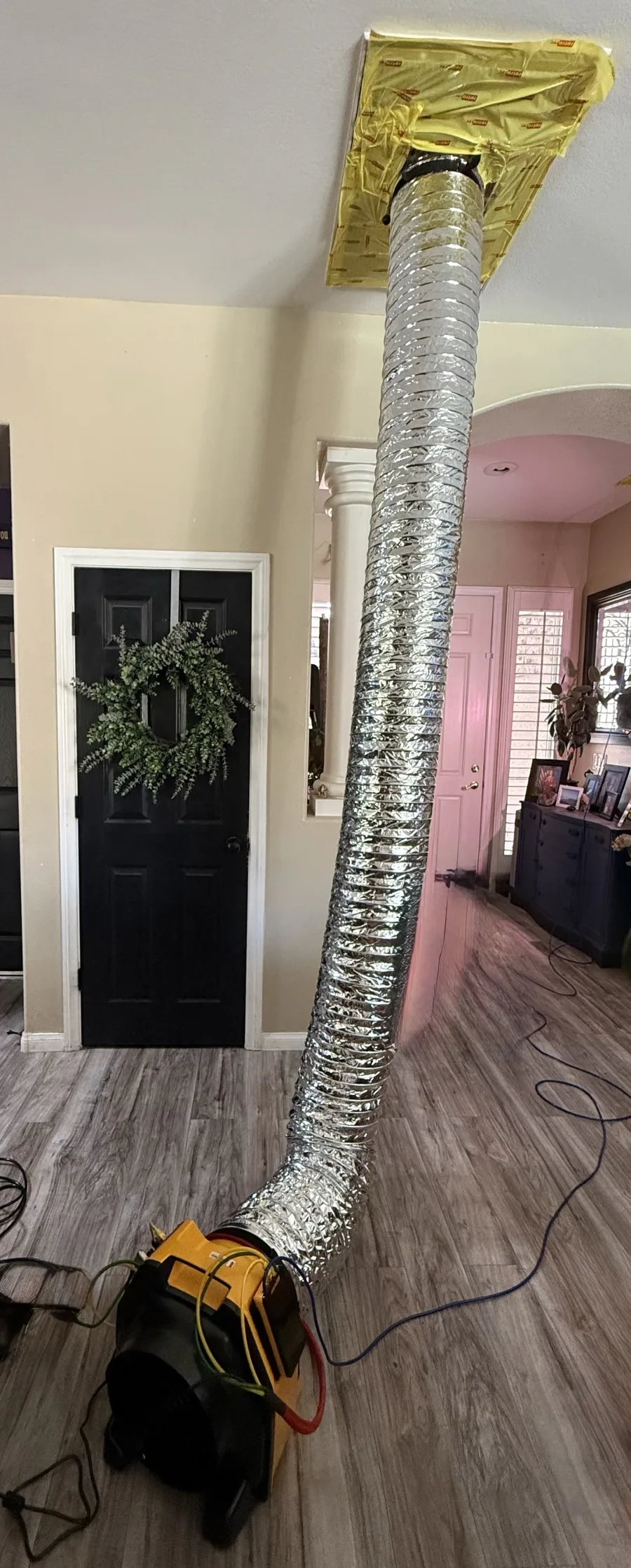
The system gets shut off first. Then we cover every supply register and return grille in the house with film, so the duct system becomes a closed box with only its leaks open to the outside. A calibrated duct-testing fan connects by flex duct to one register or to the return, and that fan becomes the only way air can get in.
The fan pushes air into the ducts until they hold a set test pressure. To keep that pressure steady, the fan has to replace whatever escapes, so the airflow it needs is the leakage, read straight off the gauge. We compare that figure to the airflow the system is meant to move, which tells you what share of your heating and cooling never reaches a room.
A number alone does not say where the holes are. With the ducts still under pressure, we go into the attic or crawl space and trace the leaks at joints, boots, takeoffs and the plenum, where moving air is easy to feel and to find. That list of locations becomes the work order for sealing, and nothing on it is a guess.
Why the Test Comes Before New Equipment
A new air conditioner or furnace bolted onto the old ductwork delivers its air into the same holes the old one did. Part of the capacity you just paid for gets spent heating or cooling the attic, the rooms that lagged before still lag, and the new unit takes the blame for a problem it inherited on day one.
Sizing goes wrong too. A replacement picked to overcome leaky ducts ends up too big once those ducts are sealed later, and an oversized system short cycles, runs louder than it should and wears its parts faster. The order that works is test, seal, then size. Our valley-wide duct leakage testing follows that sequence on every job where replacement is on the table.
Plenty of houses in Boulder City are on their second or third system by now, and each swap was a chance to test the ducts that mostly went unused. If you are weighing new equipment, have the test run first.
Shopping for new equipment for an older house?
Have the ducts tested first. Call us, or write to us about the house and we will follow up with times.
Return Leaks and the Dust on Every Shelf
The return side of a duct system runs under suction. Every time the blower starts, it pulls on the return ducts, and any opening along them draws in whatever surrounds it. In an attic that means insulation fibers and fine dust. In a crawl space it means the air down there, with everything it carries.
Where the filter sits matters. In many houses the filter lives at the return grille in the hallway or ceiling. A leak in the duct beyond that grille sits downstream of the filter, so whatever it pulls in skips filtration completely and goes through the blower, across the coil and out every supply register in the house. Homeowners who dust on Saturday and see a film again by Tuesday are often looking at exactly this.
Sealing the return usually cuts that dust noticeably, and it should come before any filtration upgrade. Once the ducts are tight, Aprilaire filtration and Reme Halo LED purification from our indoor air quality work clean the air the system actually moves, instead of air it keeps pulling in from the attic.
Sealing the Leaks, Then Proving It With a Second Test
Once the leaks are located, sealing is hands-on work in the attic or crawl space. Joints and seams get mastic, which stays flexible and holds far longer than tape. Loose boots get reconnected and strapped. Sections of flex that are torn, crushed or kinked get replaced, and the plenum connections get sealed where the ducts meet the equipment.
Then we set the fan up the same way and run the test again. The second number sits next to the first in writing, so you can see what changed instead of taking our word for it. Sealing also changes how air reaches each room, which is why a sealed system is a good time to have air balancing done.
A remodel is the other time to test. Kitchen and bath projects move registers, reroute runs and put other trades in the attic, and duct connections get bumped or left loose along the way. Testing after the work wraps up catches a disconnected run or a crushed section while the project is still fresh, before the problem settles into a room nobody can keep comfortable.
Duct Testing Questions From Boulder City Homes
How can I tell if my ducts are leaking without a test?
You usually cannot be sure. Clues include rooms that never reach temperature, heavy dust soon after cleaning, and bills that climb without any change in habits. Each of those has other possible causes, which is why we put the duct system under pressure and read the leakage directly instead of guessing.
Do you have to open walls or ceilings to test the ducts?
No. The test runs through the existing registers. We cover each supply and return opening with film, attach the testing fan to one register, and read the leakage from the gauge. Finding the specific leaks comes afterward, in the attic or crawl space where the ductwork actually runs.
Should I test the ducts before buying a new air conditioner?
Yes. A new system connected to leaking ducts loses part of its output to the attic from the first day. Testing first tells you whether sealing belongs ahead of the replacement, and it keeps new equipment from being sized to make up for leaks that will later get fixed.
Can leaking ducts make my house dustier?
They can. A leak on the return side sits under suction, so it pulls dust and insulation fibers from the attic or crawl space into the airstream. When that leak is past the filter, the blower spreads it straight through the house. Sealing the return often reduces dust in a way you can see.
We just finished a remodel. Do the ducts need testing again?
It is a good idea. Remodels move registers, reroute runs and send other trades into the attic, and duct connections get bumped or left loose. A test once the work wraps up catches a disconnected run or a crushed section while everyone involved still remembers what was changed.
What happens after the test shows leakage?
We locate the leaks, seal joints and seams with mastic, reconnect and strap loose boots, and replace torn or crushed sections. Then we run the same test again so the second number sits beside the first. Both readings go into the written results you keep for the house.
Other Jobs We Handle Around Boulder City
A duct test often leads to one of these next. Each page covers that job the way it plays out in town.
Everything we do in Boulder City · Our project gallery · Book a visit
Out US 93 to Boulder City
Boulder City is a small town with no casinos and a residential feel, about 25 miles southeast of Las Vegas. Through-traffic now swings around it on the I-11 bypass, and our trucks come out on regular calls. The map shows the town and the country around it.