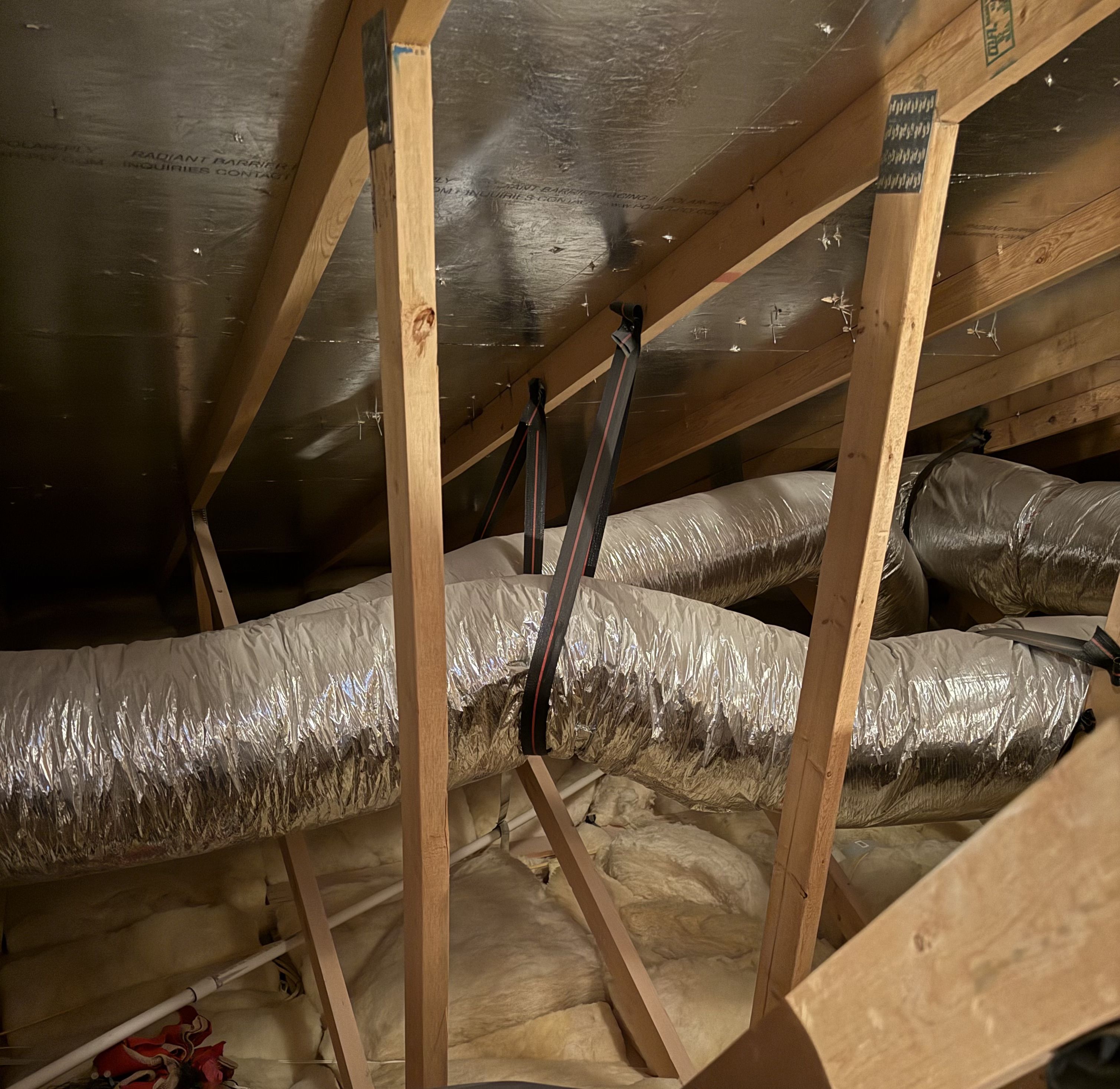
Enterprise homes sit on the valley’s active construction edge, so they eat more airborne dust than almost anywhere in Clark County, and leaky attic return ducts pull that dust straight into the HVAC system. The fix stack is unglamorous and effective: seal the ducts, install real media filtration sized to the blower, hold winter humidity up with a whole-home humidifier, and verify all of it with measurements.
Every neighborhood in the Las Vegas Valley deals with dust. Enterprise deals with more of it, for a simple reason: the bulldozers are still here. The communities south and west of the 215 are the valley’s active growth front, which means graded lots, open desert being cut for new phases, and construction traffic grinding fines into the air a few hundred yards from occupied kitchens.
Homeowners experience it as a housekeeping mystery: wipe the shelves Saturday, find the film again Wednesday. It is not housekeeping. It is air handling, and air handling has fixes that can be measured.
How the Dust Actually Gets In
The front door is not the main road in. In most Enterprise homes the highway is the return side of the HVAC system. Return ducts run through the attic, and the attic is not clean space: it breathes with the outdoors through soffit and ridge venting, and it holds whatever the wind delivered. A return duct with leaky joints or loose boot connections sits under negative pressure whenever the blower runs, so it inhales attic air, dust included, and the system then distributes that dust to every room through the supplies. The system meant to condition the air becomes the delivery mechanism for the dirt.
This is why duct sealing is routinely the first line on our Enterprise IAQ plans, ahead of any filter or gadget. Close the leak and you cut the source; homeowners see it in dusting frequency within weeks. It also returns lost cooling, since the same leaks were pulling 130 degree attic air into the system all summer.
The secondary routes matter too, and they are cheaper still. The door between the garage and the house leaks dust every time a car comes and goes; fresh weatherstripping closes it. Entry doors facing the prevailing southwest wind benefit from the same treatment. And homes backing directly onto active grading can time their ventilation, running the system fan and keeping windows shut during the workday when the equipment is moving dirt, then airing out in the evening calm. None of it is exotic. All of it shows up in the readings.
The 1-Inch Filter Trap
The next reflex is a better filter in the existing 1-inch slot, and it backfires more often than it helps. High-MERV media crammed into one inch of depth creates a pressure wall: the blower strains, airflow drops, far rooms starve, and in cooling season the coil can freeze. Protecting your lungs by choking your equipment is a bad trade.
The correct hardware is a media cabinet at the air handler, four to five inches of pleated depth with enough surface area to run MERV 11 to 13 at a civilized pressure drop. It captures the fine desert particulate a builder filter waves through, changes once or twice a year, and, installed properly, costs the blower almost nothing. As an Aprilaire partner we install and, more to the point, verify these with before-and-after static pressure readings. The full service picture is on our Enterprise indoor air quality page.
Smoke Days Are a Different Problem
A few times each late summer, wildfire smoke rides in from California or the Sierra and the valley’s air quality index goes ugly. Smoke particulate is far finer than construction dust, and the playbook inverts: instead of ventilating, you close the house, run the HVAC fan on circulate, and let the media filter scrub the indoor air on repeat. Households with asthma or COPD can add HEPA-grade bypass filtration at the air handler for those weeks; it is one of the few cases where we recommend equipment beyond the basics.
What does not work on smoke days: evaporative coolers, window fans, or any strategy that imports outdoor air. If your home relies on an evaporative cooler, plan for smoke days to be refrigerated-AC days, or at minimum know you are trading indoor air quality for the cooling.
A practical habit for those weeks: watch the air quality index the way you watch the temperature forecast, and treat a bad reading as the trigger to switch the fan from auto to on. In auto, the blower only moves air while cooling runs, so filtration happens in bursts; switched to on, the filter works continuously and indoor particle levels fall measurably within hours. It costs a little blower electricity and buys the cleanest indoor air on the block during the ugliest days of the year.
The Third Leg: Desert-Dry Air
Enterprise winters drop indoor humidity into the teens, and dry air is an air quality problem wearing a comfort costume: cracked skin, morning sinus complaints, aggravated allergies as dried nasal passages lose their natural filtering, shrinking hardwood, and static on every doorknob. A whole-home humidifier mounted at the air handler holds the house in the mid 30s to mid 40s automatically. We covered the install in detail in our whole-home humidifier post; the short version is that it pairs naturally with a filtration upgrade because both live at the same equipment.
New Homes, Tight Envelopes, and the Air They Trap
Enterprise’s newest homes add one more layer. Modern construction is tight, which is excellent for power bills and hard on indoor air: the envelope that keeps conditioned air in also keeps cooking byproducts, cleaning chemistry, and the off-gassing of new carpet, cabinetry, and paint circulating inside. A new home’s air can measure worse than a twenty-year-old home’s for its first couple of years, which surprises owners who assumed new meant clean.
The response is not to fear the tight envelope but to finish the job it started: filtration sized to the blower so the recirculating air gets scrubbed on every pass, sensible ventilation so the house can exhale, and airflow verified room by room, because a bedroom that barely receives supply air receives barely any filtration either. Tight construction plus deliberate air handling is the best combination available in this climate; tight construction alone is a sealed jar.
Measure, Fix, Re-Measure
Our IAQ assessments in Enterprise log particle counts room by room, humidity, static pressure, filtration condition, and duct leakage, and the plan that comes back is sequenced by impact. In this part of the valley it usually reads: seal the ducts, install the media cabinet, add humidity control for winter, and stop there unless the household’s health picture justifies more. Then we re-measure, because an air quality improvement that does not show up in the readings is a story, not a result. That is the same measurement-first discipline this company was founded on, applied to the air your family breathes.
Enterprise IAQ FAQ
Why is my Enterprise house so much dustier than my last house?
Active grading and construction nearby, plus return ducts leaking attic air into the system. The construction is temporary; the duct leaks are not. Sealing them plus real media filtration handles the controllable share, and the difference shows up within weeks.
What filter should I actually buy?
In a 1-inch slot, a moderate filter changed often beats a high-MERV filter that chokes the blower. The better answer is a media cabinet at the air handler running MERV 11 to 13. We size filtration to measured static pressure, not to marketing.
What should we do on wildfire smoke days?
Close the house, run the system fan on circulate, and let the media filter clean indoor air. Skip evaporative cooling and window fans until it passes. For respiratory-sensitive households, HEPA-grade filtration at the air handler is worth a conversation.
Do humidifiers help with allergies?
They help the dryness side. Air in the teens for humidity dries nasal passages until they lose their natural filtering, which makes allergy symptoms worse. Holding 30 to 50 percent keeps those defenses working; filtration handles the particle side.
Is duct sealing worth it on a newer home?
Frequently, yes. New does not mean tight; boot connections and joints leak from day one and inspection never tested them. In Enterprise the payoff is doubled because the attic air being pulled in is dustier than anywhere else in the valley.
How do I know if any of this worked?
Because we re-measure. Particle counts, humidity, and static pressure get logged before the work and after it, and you keep both sets of readings. An air quality improvement that does not show up in the numbers is a story, and we do not sell stories.
Ready to Fight the Dust Properly?
Measured IAQ plans: duct sealing, media filtration, and humidity control. 28 years serving Enterprise and the Las Vegas Valley.
Free Quote (702) 840-5163Read our Enterprise Indoor Air Quality page · More posts · Get a free quote