Jean HVAC Repair
When the HVAC quits in Jean, the nearest big-shop service truck is 25 miles away. That distance is the entire reason most local property owners learn to know one Las Vegas valley contractor by name instead of calling whoever picks up first. Constant Air Balancing & Services covers Jean as part of our regular Clark County service area, and our repair approach here is the same approach we run everywhere else: diagnose the actual failure first, document the root cause, then quote and fix the problem instead of selling around it.
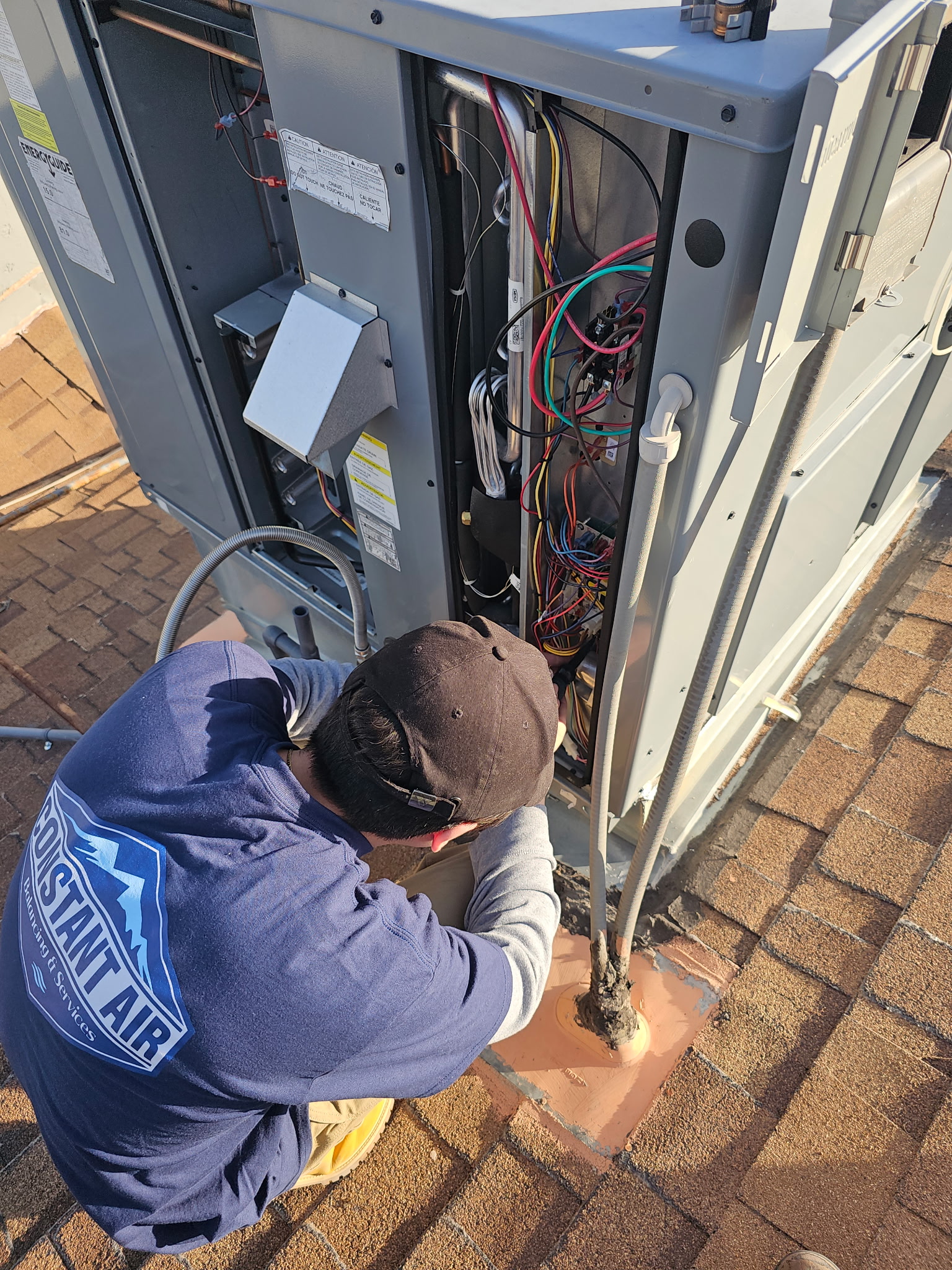
Why Jean HVAC Repair Looks Different
Jean HVAC repair is a different conversation than valley repair work for two structural reasons. First, the equipment base in Jean tends to be older than the Las Vegas valley average. Many of the residential systems we see here are 12 to 20 years old, which is the back half of the manufacturer-rated service life. Some of the hotel-adjacent staff housing equipment is older still, and a fair number of the small commercial systems along the I-15 corridor have run beyond their original rated hours. Older equipment shifts the diagnostic logic toward judgment calls about repair-versus-replace economics, not just whether a part can be swapped.
Second, parts availability in Jean is a function of how fast we can pull from Las Vegas distributors. Major brand parts like Carrier, Lennox, Trane, Goodman, and Rheem are usually same-day or next-day. Older or off-brand parts can stretch to three to five business days. That parts-supply reality is why our trucks roll to Jean with a fully loaded service bin, including universal fan motors, common contactor and capacitor sizes, refrigerant in both R-410A and R-22 equivalent dry charges, condensate pumps, ignitor and flame sensor kits, and a complete commissioning instrument set. We try hard to fix on the first visit because a return trip is a meaningful travel cost.
The third structural difference is occupancy variability. A Jean home might be a primary residence, a weekend-only desert retreat, or a manufactured-home community unit that rotates renters. Each of those occupancy patterns produces different failure modes. Primary residences fail along normal wear curves. Weekend-only homes have refrigerant leaks that go undetected for months because no one runs the system to notice. Rentals see filter neglect, thermostat abuse, and breaker resets that mask real electrical faults. Our diagnostic captures the occupancy context first so the repair fits how the home actually gets used.
The I-15 / Jean Airport Microclimate Effect on Equipment Life
Equipment life in Jean runs roughly 20 to 30 percent shorter than equipment life in shaded valley neighborhoods. That has nothing to do with the brand or the install quality and everything to do with what the outdoor unit lives through. Continuous open-desert sun exposure on the condenser, dust loading from I-15 traffic, brief but intense monsoon dust events, and overnight low temperatures that stay above the design assumption all add up. A condenser coil that would last 18 years in a shaded Henderson backyard might last 13 years in a Jean front yard with no shade tree.
The repair implication is that we look for the specific failure modes that microclimate produces. Coil corrosion is the most common, especially on aluminum coils where formic acid in dust eats microchannel fins from the outside in. Capacitor failure is the second most common because dielectric oil in capacitors breaks down faster at sustained high temperatures. Compressor terminal failure runs third, usually from heat-soaked wiring insulation that cracks and shorts to the terminal block. We carry replacements for all three on every Jean service truck.
For aviation-adjacent equipment at Jean Sport Aviation Center, the failure pattern shifts toward filter-side problems because pilot lounges and dispatch offices see a constant inflow of fine dust off the runway apron. Filter loading rates run two to three times what a typical residential filter sees. When a mini-split or central system in those buildings comes in for repair, the first checklist item is filter condition; the second is evaporator coil condition; the third is condensate drain integrity, because biological growth on heavily filtered coils backs up the drain pan and tripped float switches account for half the no-cooling calls we get from that part of Jean.
Common Jean Failure Modes by Season
Summer Jean repair calls (June through September) are dominated by capacitor failure, refrigerant undercharge, and condenser fan motor burnout. Capacitors fail because sustained 110 degree ambient temperatures push internal dielectric oil past its rated breakdown threshold. Refrigerant undercharge shows up as systems that run continuously but cannot pull the indoor temperature down, with low suction pressure and high superheat readings at the service ports. Condenser fan motor burnout shows up as a no-cooling call where the compressor is running but the outdoor unit is making no airflow, usually with the motor windings burned through.
Winter repair calls (December through February) shift to ignition system failures on gas furnaces, heat pump defrost control failures, and hard-start issues on systems that have not run all summer. Ignition system failures on Jean furnaces are typically hot surface ignitor cracks or flame sensor coating failures. Heat pump defrost issues show up as outdoor coils that ice over on cold mornings, run continuously without defrosting, and trip a high-pressure switch. Hard-start issues on the rental and weekend-occupied homes come from compressor oil migration during long off-cycles, often resolved with a soft-start kit on the right candidates.
Shoulder-season calls (March, April, October, November) are mostly preventive: thermostat replacements, filter changes, drain pan cleanings, condensate pump replacements, and the kind of low-stakes service work that should have happened on a maintenance plan. We push every Jean customer toward a twice-yearly maintenance visit because catching small problems in spring or fall prevents the high-cost summer failures.
Our HVAC Repair Process in Jean
Every Jean repair call runs the same diagnostic protocol. The technician arrives, listens to the symptom description, confirms the customer’s primary complaint, and then runs an instrumented diagnostic before quoting anything. The diagnostic captures suction pressure, discharge pressure, superheat, subcooling, return air temperature, supply air temperature, system delta-T, capacitor microfarad readings under load, contactor pull-in voltage, blower motor amp draw, and indoor coil delta-T. Numbers go onto a written diagnostic report, not just into the technician’s memory.
From that data we identify the actual failure, then quote the repair with parts and labor disclosed line-by-line. If the diagnosis points toward an end-of-life decision (a 16-year-old system with a failed compressor and corroded coil, for example), we present the repair quote alongside a replacement quote so the customer can make an economic call instead of paying for a repair that delays an unavoidable replacement by six months. Customers tell us they appreciate the transparency more than the cheapest quote.
After the repair we re-instrument the system and verify the corrected performance with a second written set of numbers. The before/after pressures, temperatures, and amp draws stay in the customer’s service record. If the system was air-balanced when we installed it originally, we re-verify the balance after any repair that changed airflow characteristics, which is one of the structural advantages of being an NCI air-balancing partner: the diagnostic instruments are the same instruments we use for balance verification, so the work flows from one into the other without bringing in a second truck.
Jean HVAC repair, diagnosed first, fixed right.
Instrumented diagnostic, written quote, parts loaded on the truck, performance verification before we leave.
Cost of HVAC Repair in Jean
Jean HVAC repair pricing depends on the part, the system age, and the refrigerant type. Electrical components are the cheapest thing we do: capacitors, contactors, thermostats, condensate pumps. Motors are the next step up, and a blower motor prices by type, since an ECM or constant-torque motor costs more than the PSC it replaces. Furnace control boards price by brand, and a communicating board runs well above a basic one. The expensive end is sealed-system work: refrigerant leak repair prices by where the leak is and how hard the joint is to reach, and a full coil replacement is the most expensive single repair on a residential system. The diagnostic is a flat fee, quoted before we dispatch, and it credits back against real repair work.
For systems older than 12 years or carrying multiple simultaneous failures, we present a repair-versus-replacement quote so the customer can weigh the economics. Replacement quotes through Constant Air Balancing & Services include Manual J load calc, full install, post-install NCI air balancing, and Clark County mechanical permit fees, with Synchrony financing options at 0 percent promo on qualifying equipment.
Jean HVAC Repair FAQ
How quickly can you get a technician to Jean for an HVAC repair?
Same-day service is usually possible for emergency calls placed before noon. Scheduled repair work typically books within one to three business days. The travel from the Las Vegas valley to Jean is part of our regular service rotation, so it does not push availability significantly.
Will you repair an HVAC system that is more than 15 years old?
Yes, when the repair makes economic sense. We present the repair quote alongside a replacement quote on older systems so you can decide based on real numbers. We do not refuse service on older equipment, but we will tell you honestly when a repair is throwing money at a system that is past its service life.
Do you carry parts for R-22 systems?
Yes. We still service R-22 equipment in Jean. We carry dry-charge replacement compressors, R-22 service equipment, and reclaim machines. R-22 refrigerant itself is expensive because of phase-out, which often shifts the math toward a replacement quote, but we do not refuse R-22 repair calls.
What does the diagnostic fee cover and is it credited if you do the repair?
The flat diagnostic fee covers the instrumented inspection: full pressure and temperature readings, capacitor and electrical component test, and a written diagnostic report. You hear the number before we dispatch. The fee credits back against any real repair invoice, so for most jobs the diagnostic effectively becomes part of the job cost rather than a separate charge.
Can you service the HVAC at Jean Airport / Jean Sport Aviation Center?
Yes. We service the mini-splits and small central systems in pilot lounges, dispatch offices, and support buildings at Jean Sport Aviation Center. Repair scope there often involves filter and coil cleaning at higher frequency because of dust loading off the runway apron.
Service Area: Jean, NV
We repair HVAC across all of Jean, NV including ZIP 89019 residential addresses, the Jean Sport Aviation Center facility, hotel-adjacent staff housing, and the small commercial and truck-stop adjacent buildings along the I-15 corridor. Service runs out of the Las Vegas valley with same-day emergency response when available.