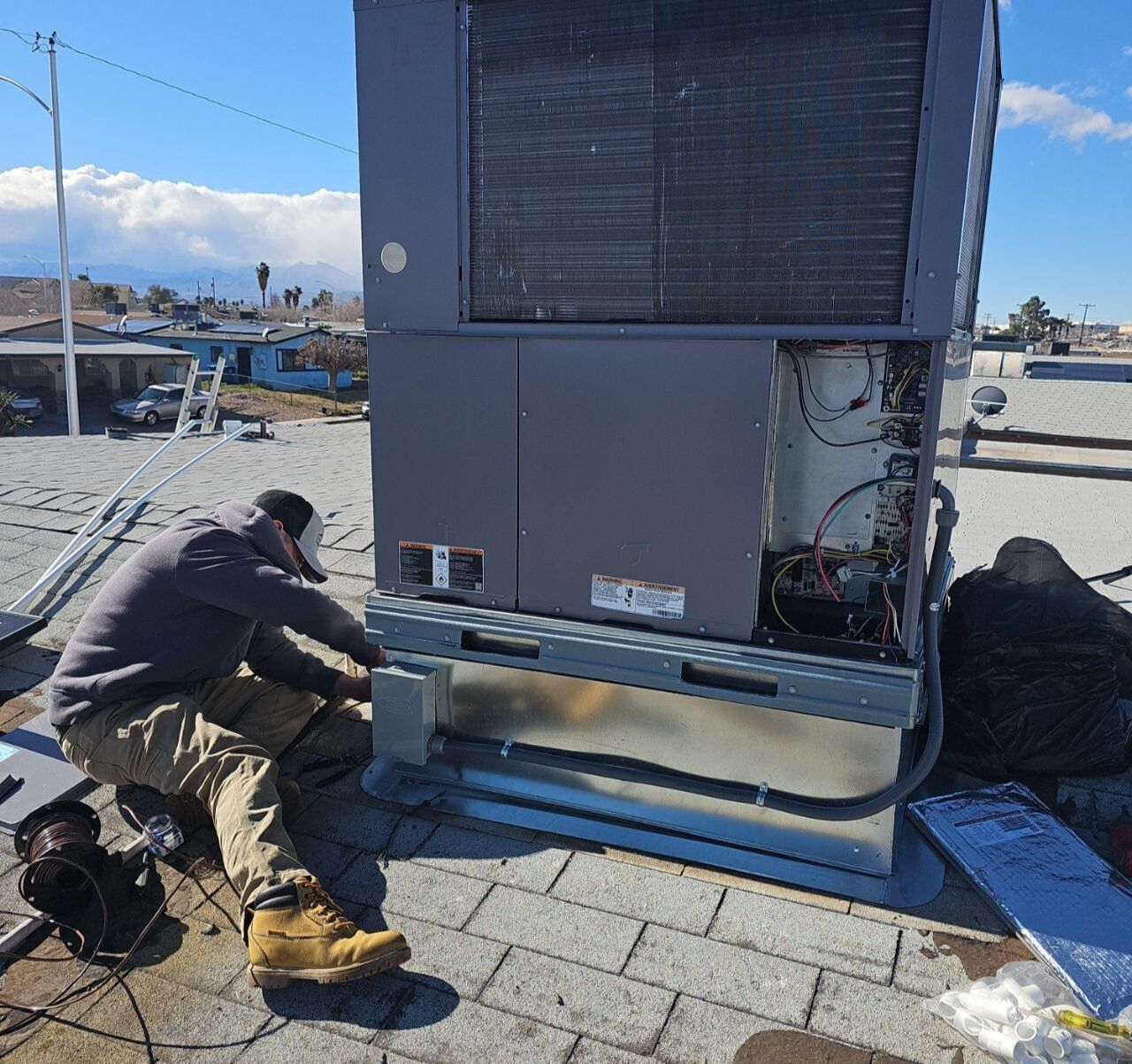
A common mistake Las Vegas, NV building owners make is calling their home HVAC contractor for commercial work. The logic feels reasonable — HVAC is HVAC, right? In practice, commercial HVAC service and residential HVAC service share a category label but diverge sharply on equipment, electrical, tooling, controls, and certification requirements. Hiring a residential contractor to service a commercial building often voids warranties, misses critical checks, and leaves problems in place that only a commercial-trained technician would catch.
This post lays out the specific technical differences between commercial and residential HVAC service so you can tell in one conversation whether a contractor is qualified for the building you’re asking them to work on. At Constant Air Balancing & Services, we run both scopes in-house with separate technician skill tracks.
What Is the Core Technical Difference Between Commercial and Residential HVAC?
Scale and system architecture. A residential system is usually one air handler, one condenser, one thermostat, one zone, using 208V/240V single-phase power. A commercial system typically has multiple rooftop units or split systems, multiple zones controlled by VAV boxes, economizers that bring in outside air, building automation controls, and 460V three-phase power. The diagnostic skills, tools, and certifications needed for commercial work don’t exist on the residential side.
How Do the Equipment Voltages and Electrical Differ?
Residential HVAC runs on 208V/240V single-phase power — what every home in Las Vegas, NV is wired for. Commercial equipment typically runs 208V/460V three-phase. A technician trained only on residential may not carry the correct test leads, may not recognize phase rotation issues, and may misdiagnose voltage-related problems. Three-phase equipment requires specific lockout-tagout procedures and higher electrical safety training.
What Controls Are Commercial-Only?
- Variable Air Volume (VAV) boxes — regulate airflow per zone. Nonexistent in residential. Require pneumatic or DDC controls knowledge.
- Economizers — bring in outside air when it’s cooler than return air. Require enthalpy sensors, actuators, and controls logic.
- Building Automation Systems (BAS) — Tridium, Distech, Honeywell. Programming and troubleshooting need specialized training.
- Demand-Control Ventilation (DCV) — CO2 sensors drive outside air supply up or down based on occupancy.
- Staging controls — multi-compressor units run 2-stage or 4-stage cooling. Residential systems are single-stage.

Why Does Runtime Matter?
A residential HVAC system in Las Vegas, NV runs 8 to 14 hours per day in summer. A commercial system often runs 12 to 20 hours per day and many run 24/7 (medical, data centers, hospitality). The wear curves diverge. A commercial compressor sees 2x to 3x the start-stop cycles and runtime hours of a residential unit over its life. Service intervals, part selection, and failure modes all shift accordingly.
What Certifications Does a Commercial Service Technician Need?
- EPA Section 608 Universal — for refrigerant handling. Applies to both but commercial work involves larger charges and different refrigerants (R-410A, R-32, R-454B).
- Nevada state mechanical contractor license — required for any work.
- NATE (North American Technician Excellence) — commercial specialty tracks exist for light commercial, commercial refrigeration, hydronics.
- Controls training from the specific BAS vendor in use (Tridium, Johnson Controls, Honeywell).
- Confined space + rooftop safety — OSHA compliance for working on roofs and in mechanical rooms.
What Tools Does Commercial Service Require That Residential Doesn’t?
- Digital manometer capable of 0.001 in w.c. resolution for VAV pressure balancing
- Flow hood for verifying CFM at commercial diffuser sizes (often larger than residential flow hoods can read)
- Three-phase meter + phase rotation tester
- BAS laptop with required software for the installed controls system
- Industrial-scale refrigerant recovery equipment rated for commercial charge sizes
- Commercial ladder or scaffold + fall protection gear for rooftop work
How Does Pricing Differ Between Commercial and Residential HVAC Service?
| Service Type | Residential (Las Vegas, NV) | Commercial (Las Vegas, NV) |
|---|---|---|
| Annual tune-up / PM | $120 to $200 | $250 to $450 per unit |
| Emergency diagnostic | $150 to $250 | $400 to $700 |
| Refrigerant leak repair | $400 to $1,200 | $800 to $3,500 |
| Full replacement | $8,000 to $16,000 | $12,000 to $60,000+ |
Commercial work costs more per visit because it takes longer, requires certified tech labor, and uses more expensive parts.
Can a Residential Contractor Legally Work on Commercial Equipment?
In Nevada, a C-21 mechanical license is required for both residential and commercial work, but commercial scope frequently exceeds the practical competency of a residential-only shop. Warranty coverage on commercial equipment (Carrier, Trane, Lennox commercial lines) often requires factory-authorized service centers, which residential shops rarely are. Using an unauthorized servicer voids the manufacturer warranty.
What Happens When a Residential Contractor Services Commercial Equipment?
Real failure modes we’ve seen at Constant Air Balancing & Services when inheriting a commercial building from a residential-only contractor:
- Economizer disconnected “because it kept opening for no reason” (it was working — bringing in free cooling)
- VAV boxes dampered closed “because they were making noise” (now every zone is starved of air)
- Refrigerant charge set by pressure gauge instead of superheat/subcooling — under or overcharged
- Belt tension “tightened until it stopped slipping” — now overloading the motor bearing
- Thermostats replaced with residential models that can’t talk to VAV controls
When Is It Okay to Use a Residential Contractor for Commercial Work?
Small commercial spaces (under 2,500 sq ft) that use residential-grade split systems can often be handled by a strong residential shop, especially for filter changes and basic electrical work. But the moment you have multiple rooftop units, any BAS controls, a VAV system, or three-phase power, commercial-qualified service is the only correct call.
Schedule Commercial HVAC Service in Las Vegas, NV
Call Constant Air Balancing & Services at (702) 840-5163 or request a walk-through quote. Our team runs both residential and commercial scopes with separate skill tracks, proper certifications, and the right equipment for each. If you’re not sure whether your building qualifies as “commercial” for service purposes, call and ask — the walk-through is free.