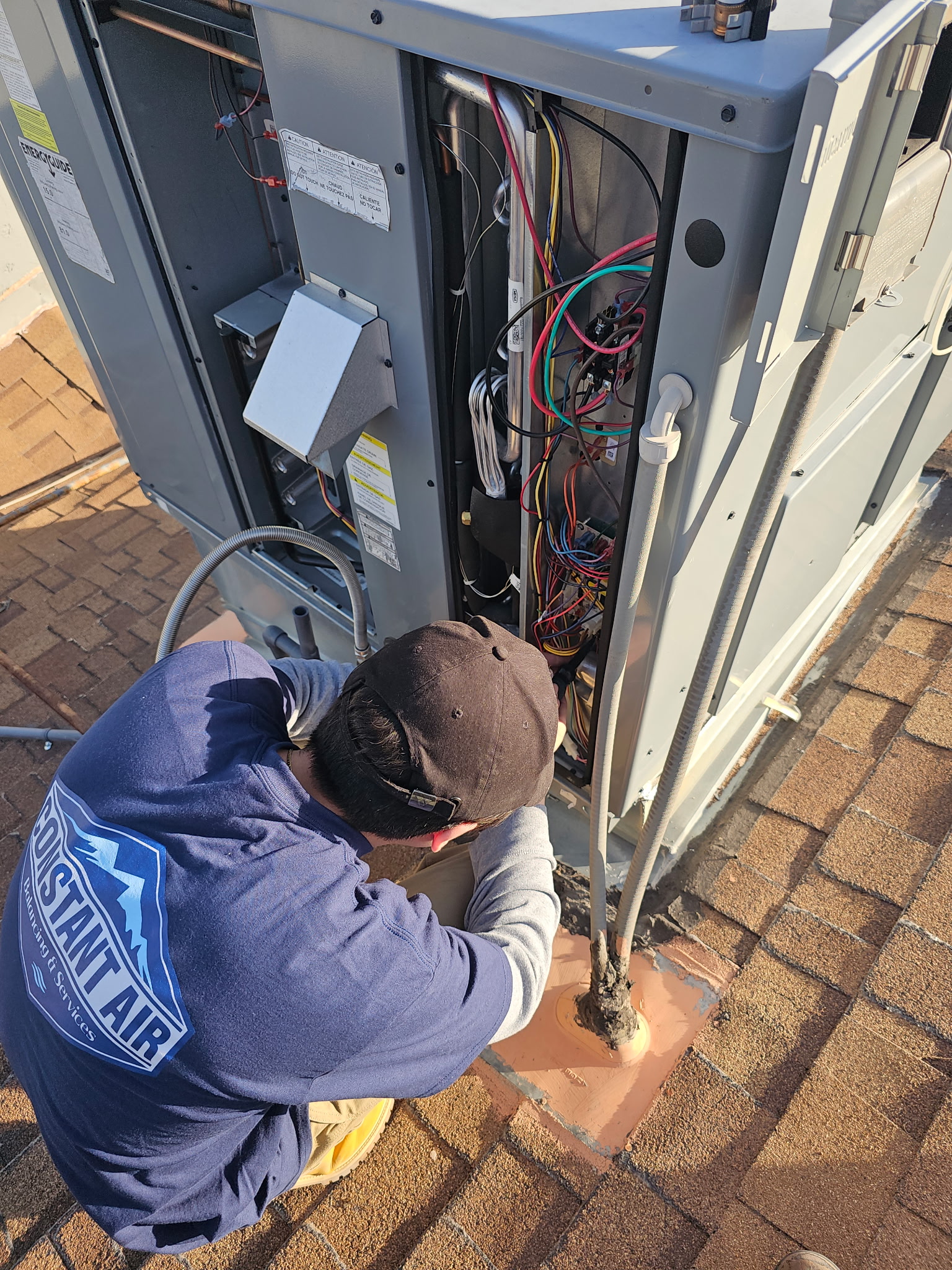
An air conditioner sized correctly for Enterprise runs nearly continuously through the worst afternoons of summer, and that is by design. Oversizing to chase faster cooling backfires: short cycles, worse comfort, higher bills, earlier failures. Right-sizing starts with a room-by-room load calculation and ends with ductwork that can actually deliver the capacity, which is where most Enterprise systems fall short.
Every June, when the first 113 degree week lands on the south valley, the same worry arrives with it: the AC has been running since noon and it has not shut off. Something must be dying. Usually nothing is dying. Usually the system is doing exactly what a correctly sized system does at design temperature, which is run.
Sizing is the most misunderstood number in residential HVAC, and in a climate as extreme as Enterprise’s it is worth understanding properly, because both mistakes, too small and too big, cost real money. And the second mistake is far more common than homeowners expect.
What 115 Degrees Actually Asks of a System
Cooling equipment is selected against a design temperature, a statistical near-worst-case for the location. For the Las Vegas Valley that number sits around 108 to 111 degrees depending on the standard used. A system sized to design will hold the house at setpoint on a 110 degree day while running almost continuously through the afternoon. On the handful of days that overshoot design, 114, 115, 116 on the exposed southern edge of the valley, a correct system may lose a degree or two indoors during the peak hours and recover in the evening. That is not failure. That is the math working.
Long, steady runs are how a properly sized system is supposed to spend the afternoon: stable temperatures, continuous filtration, maximum moisture and heat removal per watt. The system that worries you by running all day is often the healthiest one on the street.
The Oversizing Trap
The instinct says buy bigger and get headroom. What you actually get is short cycling: a five-ton unit in a three-and-a-half-ton house slams the thermostat to setpoint in minutes, shuts down, and repeats forty times a day. Starts are the hardest event in a compressor’s life, so the oversized unit ages faster. Comfort gets worse, not better: rooms near the thermostat freeze while far rooms never get a long enough cycle to come down, and the mild-day experience, which is most of the year, turns into blast-and-coast lurching.
Enterprise’s production homes make this worse because many came oversized from the builder, sized by square footage on a spreadsheet. If your system cools fast but the house never feels evenly comfortable, and if it clicks on and off constantly in April and October, that is the signature.
There is also a straightforward wallet argument. Each ton of capacity costs money to buy, and an oversized unit spends its life converting that extra purchase price into wear instead of comfort: more starts, higher inrush draws, bigger equipment breathing through the same restrictive ducts. Owners replacing a unit that always short-cycled sometimes learn the correct size is a half ton smaller than what they have been paying to run for fifteen years, and the smaller, right-sized system outperforms it from the first afternoon.
Manual J, in Plain English
The correct sizing tool is a room-by-room load calculation, Manual J in industry shorthand. It takes what your house actually is: orientation, glass area and direction, insulation levels, ceiling heights, infiltration, occupancy. A Mountain’s Edge two-story with west-facing bedroom glass and a bonus room over the garage carries a very different load map than the same floor plan facing north two streets over. The calculation produces both a total tonnage and, just as important, a per-room airflow requirement, which becomes the target the duct system has to hit.
Any replacement quote that names a tonnage without measuring your house is a guess with a price tag on it. We treat the load calculation as the first deliverable of every install we do.
Orientation alone moves the answer more than most owners believe. In the load work we run across the south valley, the same floor plan can vary by close to a ton between a west-facing lot and a north-facing one, because a wall of west glass in Mountain’s Edge takes its heaviest solar load during the exact hours the outdoor temperature peaks. The spreadsheet the builder sized from never knew which way your lot faced. The calculation does, and that is the entire point of running it.
Why the Ductwork Decides More Than the Tonnage
Capacity that cannot reach the rooms is capacity you paid for and do not receive. A four-ton condenser breathing through ducts that can move three tons of air is a three-ton system with a four-ton price and a four-ton power bill. High static pressure from undersized returns, crushed flex, and wide-open dampers is endemic in this valley, which is why we measure static pressure and register airflow on every sizing job. Sometimes the honest answer is a smaller unit plus duct corrections, which costs less and performs better. Balancing is our founding specialty, and the details live on our Enterprise AC repair and air balancing pages.
Two-Stage and Variable-Speed in the Desert
Staged and inverter-driven equipment resolves the old tension between mild days and design days. A variable-speed system loafs at partial capacity through the long shoulder seasons, quiet, efficient, steady, and opens up to full output for the July peaks. In a climate with eight months of partial load and two months of brutality, that flexibility is worth more here than almost anywhere, and it is why we lean toward two-stage as the sensible middle tier on replacements in Enterprise.
The Monsoon Wrinkle
Dry heat is the valley’s brand, but late summer brings the exception: monsoon weeks, when dew points climb and the afternoon storms roll dust and moisture across the south valley together. Humid air changes the cooling job, because the system now spends part of its capacity wringing moisture out of the air instead of dropping its temperature. Here the oversizing penalty doubles: a short-cycling oversized unit never runs long enough to dehumidify, so the house sits cool and clammy at the same time. A right-sized system running its long steady cycles handles the same air gracefully.
Monsoon season is also when the dust arrives in bulk. An outdoor coil packed with fines cannot reject heat, head pressure climbs, and effective capacity quietly drops a half ton or more, which owners misread as an undersized system. Before anyone resizes anything, the coil gets cleaned and the numbers get re-measured; more than once that alone has closed the case.
What This Means for Your House
If your system holds the house within a degree or two on the worst afternoons and runs long steady cycles, it is sized fine; spend nothing. If it short-cycles year-round or leaves the far rooms behind, measure before you replace, because the fix may be air, not iron. And when replacement time genuinely arrives, insist on the load calculation and the duct measurements up front. Financing through Synchrony is available; the honest number still comes after the measuring, not before.
AC Sizing FAQ
My AC runs all afternoon at 115 degrees. Is it broken?
Probably not. At and above design temperature, a correctly sized system runs nearly continuously and may concede a degree or two at the peak, then recover in the evening. If it also struggles on 95 degree days, that is different; get it diagnosed.
Will a bigger unit cool my house faster?
Faster at the thermostat, worse everywhere else. Oversized units short-cycle, age their compressors early, leave far rooms uneven, and cost more to buy and run. Size to the load calculation, not to anxiety about hot weeks.
What size does my house actually need?
There is no per-square-foot answer worth using. A room-by-room Manual J on your specific house, orientation, glass, insulation, infiltration, produces the tonnage and the per-room airflow targets. We run it on every replacement we quote.
Does attic ductwork change the sizing?
Substantially. Ducts in a 140 degree attic gain heat and leak capacity before the air reaches a register, and restrictive ducts choke whatever tonnage you install. Duct condition and static pressure are part of any honest sizing conversation.
Should I resize when I replace?
Reassess, always. Homes change, windows, insulation, additions, shade trees, and the original size was often a rule-of-thumb guess anyway. The replacement is the one cheap moment to correct both the size and the ducts feeding it.
Is a two-stage system worth it here?
Usually, yes. The valley spends eight months at partial load and two months at full brutality, and staged equipment serves both: quiet, efficient low-stage running most of the year, full capacity for July. It also dehumidifies better during monsoon weeks because of its longer cycles.
Sizing Questions Before the Next Heat Wave?
Load calculations, duct measurements, and straight answers. 28 years of desert HVAC across Enterprise and the Las Vegas Valley.
Free Quote (702) 840-5163Read our Enterprise AC Repair page · More posts · Get a free quote