Sandy Valley HVAC Repair
Sandy Valley HVAC systems run harder than most Las Vegas valley systems because the equipment is often older, the loads are stretched across larger square footage, and propane or off-grid power sources change the failure modes. Constant Air Balancing & Services repairs Sandy Valley HVAC the same way we repair every system: diagnostic first, measure everything that matters, fix the actual problem, document the work.
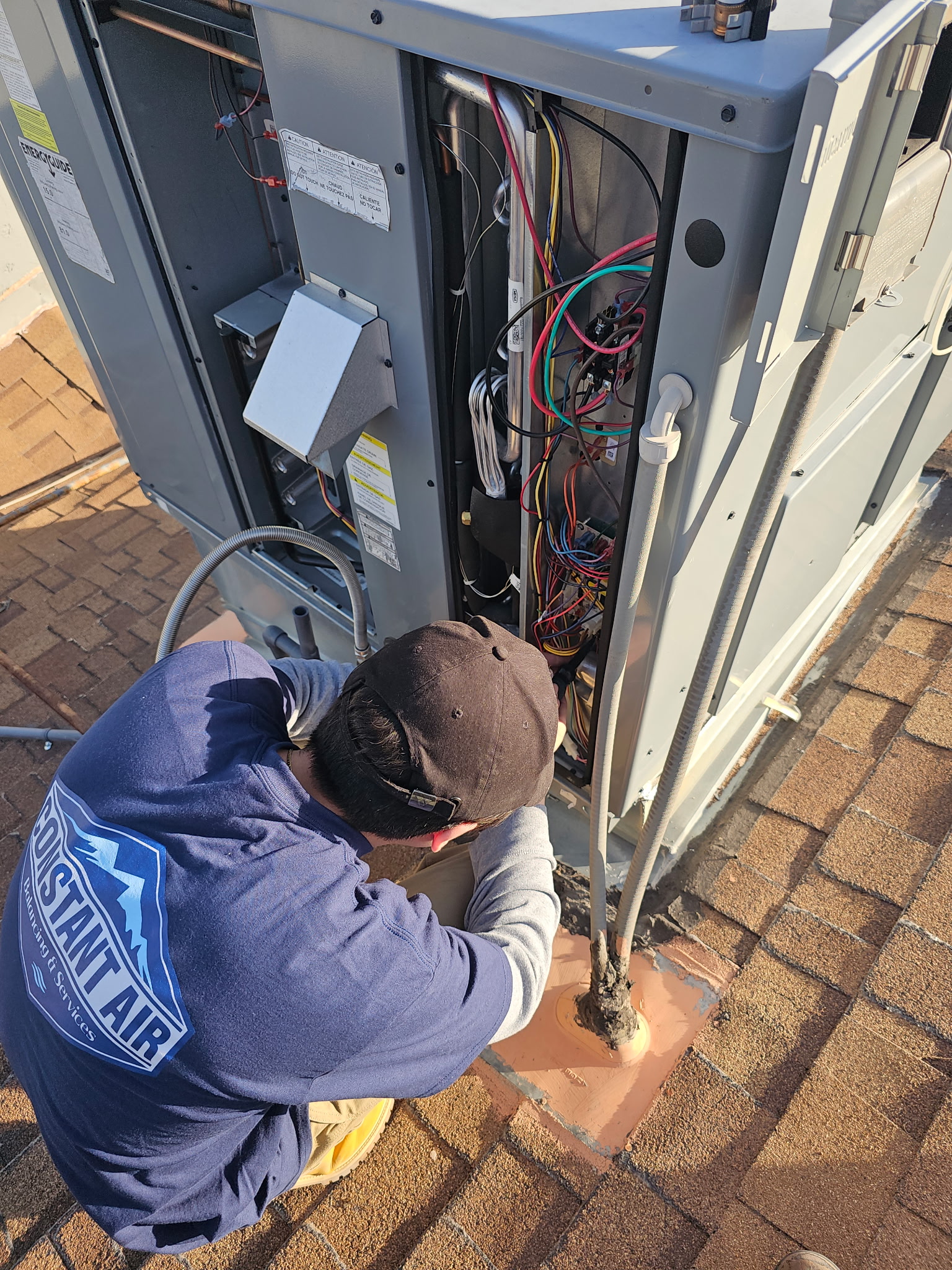
HVAC Repair for Sandy Valley Homeowners
Sandy Valley homeowners face a fundamental HVAC repair challenge most Las Vegas valley customers do not: distance. The nearest dense supply of HVAC parts and trained service techs sits 50 miles east, which means a poorly-diagnosed repair generates a 100-mile round-trip “we’ll come back with the right part” follow-up that costs everyone money and prolongs the downtime. Our diagnostic discipline matters more in Sandy Valley than almost anywhere else in Clark County. We arrive on a Sandy Valley repair call with a full inventory of common-failure parts on the truck (capacitors across the standard microfarad range, contactors, blower motors in common HP ratings, condensate pumps, refrigerant in R-410A and R-32, line-set components, and propane combustion accessories) so the typical repair completes on the first visit.
Our diagnostic costs $89 and applies toward the repair if you proceed. We measure superheat, subcooling, static pressure, amp draw, capacitor microfarads, contactor pitting, condensate trap function, supply-air temperature drop, and (for propane equipment) combustion analysis before quoting a single part. That measured approach matters more on a 30-year-old Sandy Valley propane furnace than on a 5-year-old Las Vegas valley split system because the older equipment has more failure interactions and more places where a sloppy diagnostic produces a wrong part swap.
Signs Your Sandy Valley HVAC Is on Borrowed Time
Sandy Valley HVAC equipment lives a tougher life than central Las Vegas equipment in several measurable ways. The good news is that several telltale signs show up before the catastrophic failure, and homeowners who notice them can schedule a measured-baseline visit before a 110-degree July afternoon turns into an emergency. Watch for these: rising electrical bills that have outpaced inflation for two summers running (suggesting coil fouling, refrigerant loss, or duct leakage); short-cycling where the system kicks on, runs 4 to 6 minutes, and shuts off (suggests oversize, refrigerant overcharge, or thermostat placement); ice formation on the suction line or evaporator coil (low refrigerant, dirty coil, low airflow); audible rattle from the outdoor unit (loose fan blade, failing compressor mount, debris in the fan); persistent rotten-egg or burning-plastic smell (combustion problem on propane furnaces, wiring problem on electric equipment); and condensate water pooling near the air handler closet (clogged trap, failed pump, frozen coil melting).
For propane furnaces specifically, watch for delayed ignition (lazy yellow flame instead of crisp blue), excessive condensation on cold-weather windows that did not produce condensation last year (suggesting the propane combustion is incomplete and producing extra water vapor), or visible soot deposits on the burner assembly. We perform combustion analysis on every Sandy Valley propane furnace service call regardless of the reason for the visit because catching incomplete combustion early protects both the equipment and the household oxygen levels in a tightly-sealed modular home.
The Pre-2000s Rural Systems We Repair Most
The majority of Sandy Valley homes we repair have HVAC systems installed in the 1990s, often as part of the original modular delivery or the first major remodel. Common configurations include propane down-flow furnaces with electric-only AC condensers, packaged HVAC units (gas furnace + AC in one outdoor cabinet) installed on a concrete pad at the side of the home, and mini-split heat pump systems that homeowners installed as supplemental cooling on rooms the original ductwork could not reach. Each configuration has its own failure pattern and repair history.
Pre-2000s propane furnaces typically need pilot assembly cleaning or igniter replacement every 8 to 12 years, blower motor capacitor replacement around year 10, and full blower motor replacement somewhere between years 15 and 22. The cooling-side condensers paired with these furnaces almost always need their original R-22 refrigerant replaced because R-22 production ended in 2020 and supplies are scarce and expensive; we recommend full coil-and-condenser replacement with an R-410A or R-32 system rather than chasing the dwindling R-22 supply. Packaged units from the 1990s have their own quirks: condensate routing inside the cabinet often fails when the internal drain pan rusts through; we replace the pan as part of any major repair rather than letting the next visit start with water damage. Mini-splits installed in Sandy Valley garages and converted spaces commonly have failed condensate pumps (the lift requirement defeats cheap pumps), failed wireless thermostats (battery corrosion from temperature swings), and refrigerant leaks at line-set flares that were not tightened to spec at install.
Sandy Valley HVAC repair done right.
Measured diagnostic, written quote, parts on the truck. $89 diagnostic applies to the repair.
Sizing and Rightsizing for Sandy Valley Heat Load
One of the most common Sandy Valley repair-versus-replace conversations starts with a question the homeowner already knew the answer to but wanted confirmed: “is my system the right size for this house?” Often it is not. Many Sandy Valley homes were equipped at build-time with HVAC sized to a guess rather than a Manual J load calc, and many additions and remodels never updated the equipment to match the new square footage. Oversized systems short-cycle, leave the air feeling clammy on monsoon days, drive up electrical and propane bills, and wear out the compressor years early. Undersized systems run continuously in July, never quite catch up, freeze evaporator coils when the system cannot pull the heat out fast enough, and tend to fail dramatically at the worst possible moment.
When we are out for a repair, we offer a Manual J review at no extra charge so you know whether your existing system is the right size for the actual property. If the answer is “yes,” we proceed with the repair. If the answer is “no,” we put both options on paper (repair the existing wrong-size system or replace with right-size equipment) and you choose. We do not pressure replacement; many Sandy Valley homeowners legitimately want to get five more years out of an undersized system before investing in a right-size install, and that is a defensible decision when the existing equipment still has runway.
Pricing for Sandy Valley HVAC Repair
Sandy Valley HVAC repair pricing reflects the parts cost plus a flat scheduling fee for the 50-mile travel rather than per-mile billing. Capacitor and contactor replacements run $200 to $360. Blower motor replacements run $520 to $920. Refrigerant top-off with leak repair runs $400 to $780. Propane furnace pilot/igniter service runs $260 to $420. Combustion analysis is included on every propane furnace visit at no extra charge. Evaporator coil replacement runs $1,500 to $2,600. Condensate pump replacement runs $260 to $420. Mini-split head-unit board replacement runs $480 to $740. Major component failures (compressor, full coil assembly, full blower assembly) on equipment over 15 years old frequently make replacement of the whole system more economical than repair; we run the math both ways in writing during the diagnostic so you can decide.
What Our Sandy Valley Customers Ask
Do you really come out to Sandy Valley for repairs?
Yes. Sandy Valley is part of our Clark County service area and we run scheduled and emergency dispatch out there year-round. We carry a parts inventory on the truck sufficient for most common repairs so the typical Sandy Valley call completes on the first visit.
How fast can you get to a no-cooling emergency in Sandy Valley?
Same-day response on Sandy Valley calls received before noon Monday through Saturday. After-hours emergency dispatch is available with a flat scheduling premium. The drive from our dispatch area is roughly 60 to 75 minutes depending on traffic on I-15 and Highway 161.
Do you repair propane furnaces in Sandy Valley?
Yes. We repair all major propane furnace brands and perform combustion analysis on every visit. We pull the propane regulator vent clearance, igniter wiring, gas valve manifold pressure, and burner assembly readings, then quote the repair against measured results. Sandy Valley high-altitude burner adjustments are part of our standard service.
Can you service an off-grid Sandy Valley HVAC system?
Yes. Off-grid HVAC repair requires careful attention to the inverter’s surge capacity, the battery state of charge during the diagnostic, and the soft-start kit functionality. We have repaired HVAC on solar-plus-battery, generator-only, and hybrid grid-tied configurations throughout Sandy Valley.
What brands do you repair in Sandy Valley?
All major residential brands: Carrier, Trane, Lennox, Goodman, Rheem, American Standard, York, Day & Night, Bryant, Amana, plus Mitsubishi, LG, and Daikin mini-splits. We service packaged units, propane down-flow furnaces, electric-resistance and heat-pump systems, and mini-split installations.
Service Area: Sandy Valley, NV
We repair HVAC across all of Sandy Valley, NV including properties along Highway 161, the Sandy Valley K-12 School area, the spread-out ranches and homesteads on multi-acre lots throughout ZIP 89019, the California-border-adjacent residences, and off-grid solar-plus-generator properties scattered across the wider Sandy Valley footprint.