Spring Valley HVAC Repair
Spring Valley HVAC repair is a different job than HVAC repair anywhere else in Clark County. The township sits directly downwind of the Red Rock Canyon foothills, which means every outdoor unit out here is fighting a continuous fine-dust load that affects coils, contactors, and capacitor service life. Our repair process starts with a real diagnostic, not a parts swap, and ends with a system that runs the way the manufacturer intended. Call (702) 840-5163 for same-day service in peak season.
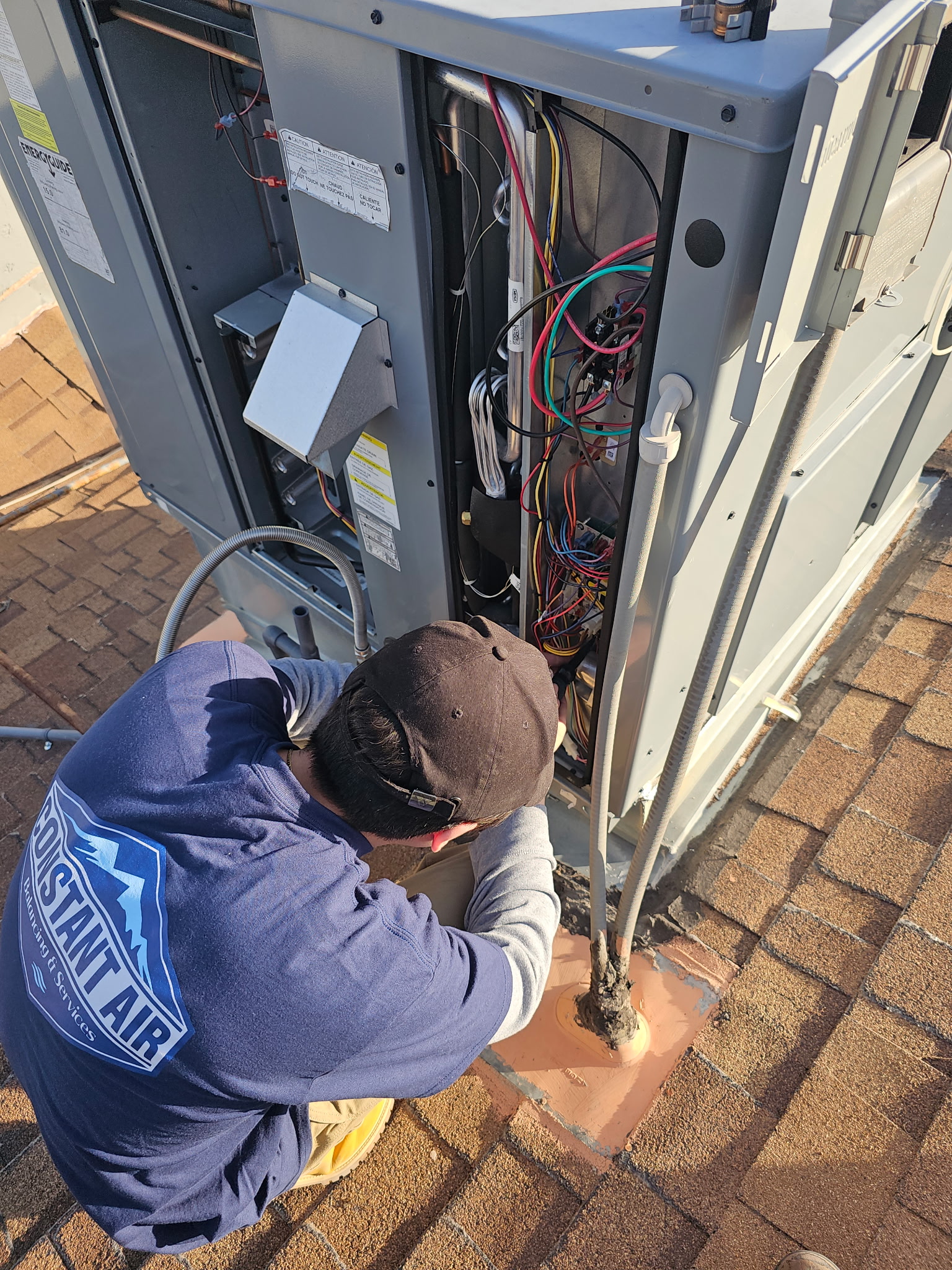
Why Spring Valley HVAC Fails Differently
Spring Valley HVAC repair is not the same job as HVAC repair in Henderson, Summerlin, or even the older Strip-adjacent parts of Paradise. The township runs from the Strip corridor west to the Red Rock Canyon foothills, which means everything sitting outdoors is exposed to a continuous load of fine, abrasive dust pulled in off the foothills by the prevailing west and southwest winds. That dust packs into condenser coil fins, builds up on contactor surfaces, gets pulled through return air paths in homes that have ductwork penetrations in the attic, and degrades capacitor performance faster than what you would see in Anthem or out toward Lake Mead. The result is that Spring Valley HVAC failures tend to come in waves tied to wind events, not to thermostat misuse.
Layered on top of the dust load is the age of the housing stock. The bulk of Spring Valley single-family residential was built between 1995 and 2010, which puts the original HVAC equipment squarely at the end of its 15 to 20 year service life. We are now seeing the third generation of failures on the same systems: first the capacitor goes around year eight, then the contactor at year eleven, then the compressor or evaporator coil somewhere between year fourteen and seventeen. Each of those failures looks isolated until you pattern them against equipment age, and then the right answer becomes obvious. Our diagnostic separates root cause from symptom, so the repair we recommend actually solves the problem instead of just buying you another six weeks.
The Red Rock Corridor Dust Effect on Cooling Load
The fine dust that comes off the Red Rock Canyon foothills and rolls east across Spring Valley is the single biggest variable affecting HVAC repair frequency in this part of Clark County. Condenser coil fouling is the obvious one: every spring we pull condensers in Rhodes Ranch, Spring Valley Lake, and along the Buffalo Drive corridor that are running at 40 to 50 percent of rated heat rejection because the coil is packed solid with the previous year’s dust. The fix is a real coil cleaning, not a garden-hose rinse from the outside, and it restores roughly 25 percent of the system’s cooling capacity in one service call.
Less obvious is the indoor side. Spring Valley homes near Spring Mountain Ranch State Park, Sun Valley, and the Mountain’s Edge fringe pull dust through any return air leak in the attic ductwork. That dust loads up evaporator coils, restricts airflow across the cold side, and causes refrigerant pressures to read incorrectly on a routine gauge check. Techs who do not factor in coil fouling will misdiagnose a clean system as low on refrigerant and add charge that does not belong there, which then causes high head pressure on the next 110 degree day and trips the high-pressure switch. We measure subcooling, superheat, and static pressure on every diagnostic, and we look at the coils with eyes on, not just gauges.
Common Spring Valley Failure Modes by Season
Spring Valley HVAC repair calls cluster by season in patterns we can predict from years of running this market. April through May is dominated by capacitor failures on systems that sat dormant through winter. The capacitor degrades from heat cycling, the system starts up the first 90 degree day, and the compressor draws locked-rotor amps trying to start with a dead capacitor. June through August is the dust-load season, with condenser coil fouling causing high-head-pressure faults and refrigerant pressures that read confusingly on a clean gauge set. Late August through September brings monsoon humidity, which exposes any weakness in condensate management: clogged primary drains, failed condensate pumps in attic-installed air handlers, and water damage to ceilings below the unit.
October and November are when furnace season problems surface. Most Spring Valley homes run gas furnaces from the same era as the AC, and the burner assemblies have not been cleaned in years. Common findings are dust-fouled flame sensors that cause short-cycling, gas valves that have been kept on standby pressure for six months and stick on first call, and induced draft motor bearings that fail under load after the first cold night. December through February is the lightest call volume but the highest-stakes calls because no heat in a 35 degree Vegas overnight is a real problem. Diagnostics get prioritized for same-day response in this period.
Our HVAC Repair Process in Spring Valley
Every Spring Valley HVAC repair runs through the same diagnostic sequence regardless of the symptom. Step one: confirmation of the actual complaint, in writing, with thermostat setpoint and indoor temperature readings. Step two: full visual inspection of the outdoor unit, indoor unit, and accessible ductwork, looking for the obvious things that get missed (tripped breaker, dirty filter, closed dampers, ice on the evaporator). Step three: electrical diagnostic with a meter on capacitors, contactors, motor amp draw, and control board signaling. Step four: refrigerant-side diagnostic with subcooling and superheat measurements at outdoor temperatures above 85 degrees, never quick-charge guesses. Step five: airflow diagnostic with static pressure measurements at the air handler.
The output is a written repair recommendation with three options when the situation supports them: the immediate repair to get the system running today, the broader repair that addresses the root cause and prevents the next failure, and the replacement comparison if the system is at end of life. We do not push replacement when repair is the right call. We also do not push repair when the math on replacement makes more sense over a five-year horizon. The recommendation reflects what we would do on our own equipment.
Cost of HVAC Repair in Spring Valley
Spring Valley HVAC repair pricing depends on the failure mode. Typical ranges for common repairs: dual-run capacitor replacement $185 to $285 including labor and diagnostic; contactor replacement $245 to $345; condenser fan motor replacement $485 to $785 depending on horsepower; evaporator coil clean and treat $325 to $485; refrigerant leak diagnostic plus repair $385 to $1,200 depending on leak location; compressor replacement $1,800 to $3,200 depending on tonnage and parts availability; full evaporator coil replacement $1,400 to $2,400. Diagnostic fee is $89 in peak season and is applied to the repair if you proceed. Synchrony financing is available for larger repairs. We never run a repair without a written quote first, and we never start work without your sign-off.
Spring Valley HVAC repair, diagnostic first.
Real measurements, written quote, no parts cannon. Same-day service in peak summer when we can schedule it.
Spring Valley HVAC Repair FAQ
Can you get to my Spring Valley home same day in summer?
In most cases yes, depending on call volume and time of day. We prioritize Spring Valley calls because we have technicians who live and work this side of the valley, which cuts drive time from Rainbow Boulevard to Mountain’s Edge to under 20 minutes. Calls coming in before 10 AM during peak summer almost always get same-day service. Calls after 3 PM may roll to next-morning first appointment depending on what is already booked.
My system runs but a back bedroom never cools. Is that a repair issue?
Sometimes yes, sometimes no. The most common cause in Spring Valley homes built 1995 to 2005 is undersized or leaky return air ductwork starving the supply side, which is actually an airflow problem, not a refrigerant problem. Other causes are a partially closed damper, a crushed flex duct in the attic, or a register boot disconnected from its branch. We measure airflow at the register and static pressure at the air handler to separate ductwork issues from refrigerant or equipment issues before we recommend any repair.
How do I know if my Spring Valley HVAC needs repair or replacement?
Three honest signals. First, age: 12 years and under, repair is usually right; 15 plus, replacement starts to win on math. Second, repair history: if you have had two or more significant repairs in the past 24 months on the same system, the next failure is coming and replacement makes sense. Third, refrigerant type: R-22 systems are increasingly expensive to recharge because the refrigerant has been phased out, and a major leak on an R-22 system is often a replacement trigger. We give you the honest assessment, not the one that pays us more.
Do you charge a diagnostic fee in Spring Valley?
Yes, $89 during peak season (May through September), $69 off-peak. The diagnostic fee is applied toward the repair cost if you proceed with the recommended work. We charge a diagnostic fee because a real diagnostic takes 45 to 75 minutes with meters, not five minutes of squinting at the outdoor unit, and we are not running parts-cannon repairs to recoup time.
What if my system is still under manufacturer warranty?
Most Carrier, Lennox, Trane, Goodman, and Rheem residential systems carry 10 year parts warranties from original installation date, provided the system was registered. We will check warranty status before quoting, source warranty parts when applicable, and bill only the diagnostic, labor, and any non-warranty consumables. If the original installer is no longer in business (common with builder-installed systems from 2005 to 2010), we can typically still process warranty claims through the manufacturer directly.
Other Spring Valley HVAC Services
View all Spring Valley, NV HVAC services · See our work · Get a free estimate
Service Area: Spring Valley, NV
We repair HVAC across all of Spring Valley including Rhodes Ranch, Spring Valley Lake, the Mountain’s Edge fringe, the Buffalo Drive corridor, Rainbow Boulevard, Jones Boulevard, Tropicana Avenue, Sun Valley, the neighborhoods near Spring Mountain Ranch State Park, and ZIP codes 89117, 89147, and 89148. Same-day service in peak summer when we can schedule it, written diagnostic on every call, no parts cannon.