Paradise HVAC Repair
Paradise homes built between 1965 and 1995 carry the bulk of HVAC repair work we do in this township. Mid-century single-stage equipment, plenum runs in shallow attics, and original ductwork that has been “repaired” with foil tape for two decades. Constant Air Balancing & Services repairs the actual failure point with NCI-certified diagnostics, not the part the previous tech guessed at.
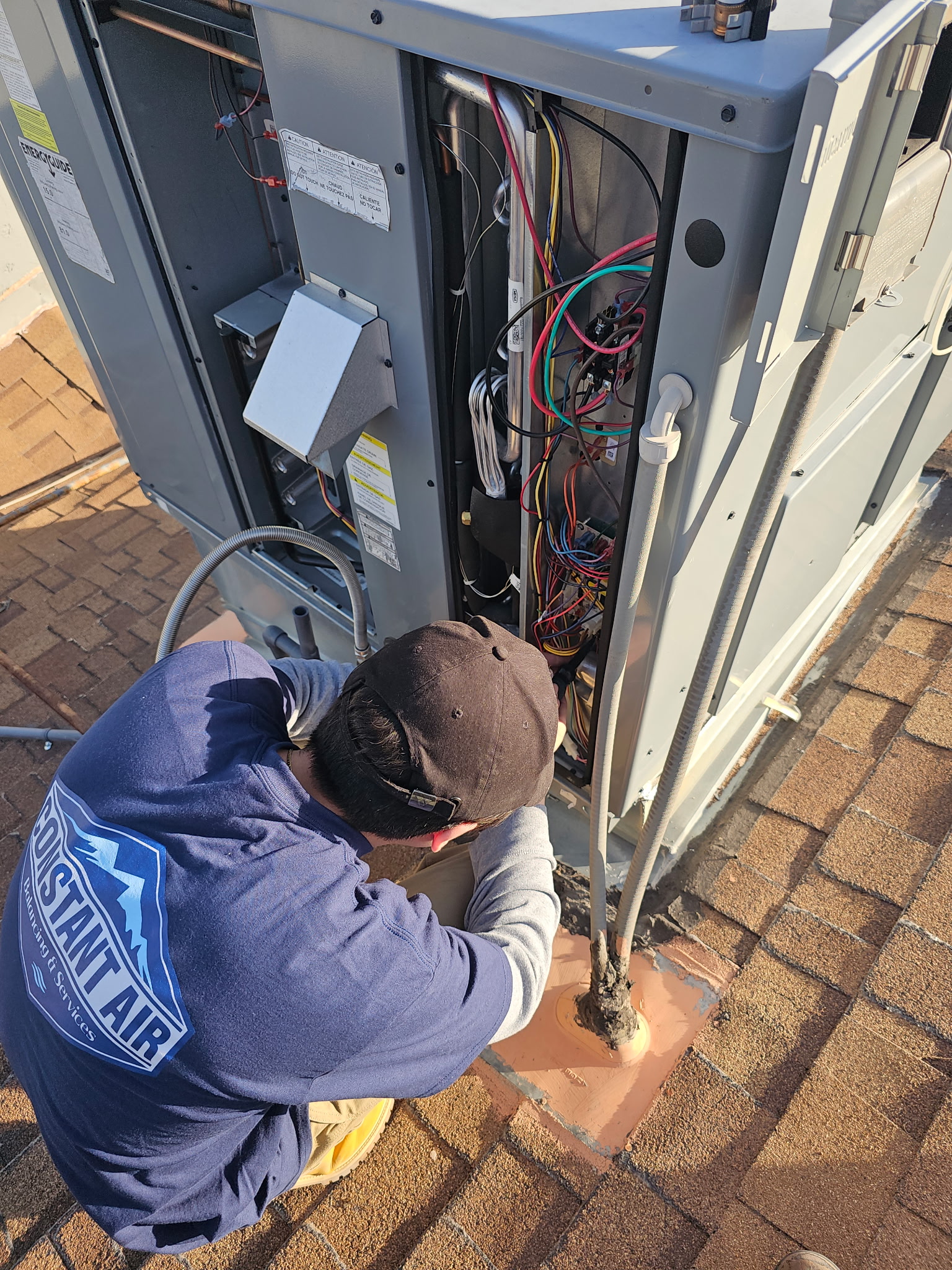
HVAC Repair for Paradise Homeowners
Paradise residents call us most often because the AC stopped cooling, the furnace will not light, or one zone of the house has been “always hot” for years without resolution despite multiple previous service visits. The common thread on those calls is that earlier repairs targeted symptoms instead of root causes. We start every Paradise HVAC repair with a complete diagnostic: refrigerant pressures, electrical loads, airflow at the supply registers, static pressure across the evaporator, and a combustion check if there is a gas appliance involved.
Most Paradise repair calls finish on the first visit because we stock the high-failure parts (capacitors, contactors, fan motors, condensate float switches, igniters, flame sensors) on every truck. When a repair requires an OEM part we do not carry, we order it and complete the work within 24 to 48 hours, not “we will call you next week.”
Signs Your Paradise HVAC Is on Borrowed Time
Paradise homes built before 1995 frequently still run their original equipment. The signs an HVAC system is approaching the end of its service life are consistent: repair costs rising year over year, capacity dropping (the system runs longer to hit setpoint than it used to), R-22 refrigerant top-off on the service report, audible compressor labor at startup, condenser coil corrosion visible on the outside fins, and increasingly long off-cycle times before the system restarts. When three or more of those signs are present and the system is older than 14 years, we walk through repair-vs-replace math openly so you can make the financial call.
The 1970s-90s Systems We Repair Most
The dominant Paradise repair archetype is a 1985-1998 vintage Carrier, Trane, or Lennox split-system AC paired with an upflow gas furnace in a hall closet. Common failures: capacitor (rolling failure as the part ages, often replaced 2 to 3 times across the system’s life); condenser fan motor (single-speed PSC motors fail at the 12 to 15 year mark); contactor (pitting from arc-cycling, replaces in 25 minutes); evaporator coil leaks at the U-bend joints; and gas valve / control board on the furnace side. We carry universal replacements for all of these.
Newer Paradise homes (2005-2020) have their own failure pattern: ECM blower motor module failures, smart-board firmware issues, and condensate float switch problems caused by mineral buildup in the drain pan. These repairs are usually quick once diagnosed, but require the right replacement module which we stock for the major manufacturers.
Paradise HVAC down? We dispatch same-day.
Diagnostic-first, written quote before any repair work. Most calls finish on the first visit.
Sizing and Rightsizing for Paradise Heat Load
A common Paradise HVAC repair conversation turns into a sizing conversation. When the original 1980s equipment was installed, sizing was done by square footage rule-of-thumb, almost always resulting in oversized systems for the actual envelope. Paradise’s mature landscaping (Aleppo pine canopy on many streets) reduces solar gain enough that the original 4-ton system is doing the work of a 3-ton system today, and at significant comfort cost (short cycles, poor humidity control). When repair cost is a meaningful fraction of replacement cost on an oversized aging system, we offer a rightsized replacement quote that often comes in at lower equipment cost than the customer expects.
Pricing for Paradise HVAC Repair
Paradise diagnostic fee runs $89 to $129 depending on system complexity, waived if you proceed with the repair. Common repair pricing: dual-run capacitor $180 to $320; contactor $220 to $380; condenser fan motor $450 to $750; evaporator coil leak repair $480 to $1,400; evaporator coil replacement $1,800 to $3,200 with refrigerant; compressor replacement on aging equipment $2,400 to $4,800 (triggers repair-vs-replace discussion); furnace igniter $220 to $340; furnace gas valve $380 to $620; furnace control board $480 to $780. All repairs include the post-repair verification (pressures, amp draws, temperature split) and a written service report.
What Our Paradise Customers Ask
Can you still service R-22 systems in Paradise?
Yes. We stock recovered R-22 and can charge a leaking R-22 system as a temporary fix while you evaluate replacement. Current R-22 pricing runs $200 or more per pound when available, which usually makes a leaking R-22 system uneconomical to keep refilling. We will walk through the math openly.
Why does my Paradise AC freeze up every summer?
Most commonly: low refrigerant from a slow leak, or restricted airflow from a clogged filter, dirty evaporator coil, or undersized return air path. We measure refrigerant charge and static pressure to pinpoint which one. Both are repairable; only one of them is the actual root cause.
How fast can you respond to a Paradise HVAC emergency?
Same-day or next-day during peak summer (June through August). After-hours emergency dispatch is available for system-down conditions. Off-season we typically schedule within 24 to 48 hours.
Do you service Paradise condo HVAC equipment?
Yes. We service split-system AC, PTAC units, mini-splits, and chiller-fed fan coils in residential towers along Flamingo, Paradise, Tropicana, and Harmon. Building access coordination is handled as part of the service call.
Do you give written warranties on Paradise HVAC repairs?
Yes. 90 days on diagnostic repairs, 1 year on major repairs (compressor, evaporator coil, heat exchanger). Parts carry manufacturer warranties. Your service report lists warranty terms in writing.
Service Area: Paradise, NV
We repair HVAC across all of Paradise, NV including University Park, McNeil Estates, Paradise Crest, Spring Mountain, the Maryland Parkway and Paradise Road residential corridors, Flamingo Road and Tropicana Avenue neighborhoods, UNLV-adjacent housing, Twain Avenue, and the off-Strip resort-service streets.